Introduction
Here’s a hard truth: Millions of people get off-grid solar system sizing wrong.
Not by a little. By enough to cost them $2,000–$8,000 in wasted money or leave them powerless during cloudy weeks.
Some undersized their panels. Now their batteries never fully charge in winter, forcing constant rationing and stress. Others oversized everything “to be safe” and spent $15,000 more than necessary on capacity they’ll never use.
Both mistakes are 100{176fcca6730a93a81d392d3d2de5285aaf114f6257de59f55b47dc4f356ad4a2} preventable.
The difference between a system that works flawlessly for 25 years and one that constantly disappoints? Correct off-grid solar system sizing. Not luck. Not guessing. Not copying someone else’s system.
In this guide, I’ll walk you through the exact engineering formulas professional solar installers use—broken down into simple, step-by-step calculations you can apply to your own system. Whether you’re planning a cabin, RV, or full-time home, learning off-grid solar system sizing will help you choose the right solar panels, battery capacity, system voltage, and inverter without overspending or falling short.
By the end, you’ll know:
- ✅ How many solar panels you actually need
- ✅ How much battery capacity to install
- ✅ What system voltage to choose
- ✅ How long your system can run on stored energy
- ✅ How to avoid the 6 biggest sizing mistakes
Everything is backed by real solar radiation data, battery specifications, and 10+ years of off-grid system design experience.
Let’s begin.
Why Correct Sizing Matters

Off-grid systems have zero tolerance for sizing errors.
With a grid-tied system, you have backup – the utility grid. Size it slightly wrong and you just adjust your expectations. But off-grid? You’re on your own.
The Cost of Undersizing
Undersized panels:
- Batteries never fully charge on cloudy/winter days
- System voltage drops to 48V → 45V → 40V (inverter shuts down)
- You lose power for 2-3 hours each evening
- Batteries discharge deeply every night (degrading their lifespan from 10 years → 4 years)
- Real cost: Replace batteries every 4 years instead of 10 = $30,000+ extra over 20 years
Undersized battery bank:
- You run out of stored energy after 1-2 days of clouds
- Forced to run a backup generator constantly (fuel cost: $2-4/hour)
- Or ration power: no hot water, cold appliances, no heating
- Quality of life tanks
The Cost of Oversizing
Oversized panels:
- Extra $5,000-$10,000 upfront for capacity you never use
- Payback period stretches 2-3 years longer
- Takes up more roof/ground space
Oversized batteries:
- Extra $8,000-$15,000 in battery bank cost
- Slower charge/discharge cycles (less efficient aging)
- Wasted money on unused storage
Correct Sizing: The Sweet Spot
A properly sized system:
- Runs 25+ years without compromise
- Covers 100{176fcca6730a93a81d392d3d2de5285aaf114f6257de59f55b47dc4f356ad4a2} of your needs year-round
- Has 10-25{176fcca6730a93a81d392d3d2de5285aaf114f6257de59f55b47dc4f356ad4a2} safety margin (not overkill)
- Maximizes ROI
- Provides peace of mind
The difference? Spending 2-3 hours on calculations now versus regret for 20 years.
Step 1: Calculate Your Daily Energy Consumption
Everything flows from this number. Get it wrong and everything downstream is wrong.
Method A: From Your Electric Bill
If you currently have grid electricity, pull your last 12 months of bills.
Look for total kWh consumed each month, then divide by days:
Daily Energy = Monthly kWh ÷ 30 days

Example: 450 kWh/month ÷ 30 = 15 kWh/day
But don’t stop there. Check winter vs. summer variation:
- Winter months often 20-40{176fcca6730a93a81d392d3d2de5285aaf114f6257de59f55b47dc4f356ad4a2} higher (heating, lighting long nights)
- Summer months lower (AC doesn’t run as long off-grid)
- Use winter average for sizing (guarantees year-round reliability)
Method B: List Your Appliances
No electric bill? Build a consumption table:
| Appliance | Power (W) | Hours/Day | Daily Energy (Wh) |
|---|---|---|---|
| LED lights (5 bulbs, 10W each) | 50W | 6 hours | 300 Wh |
| Refrigerator | 200W | 10 hours | 2,000 Wh |
| Water pump | 800W | 1.5 hours | 1,200 Wh |
| Washing machine (avg weekly) | 500W | 1 hour | 500 Wh |
| Space heater (winter) | 1,500W | 4 hours | 6,000 Wh |
| Water heater (on-demand) | 4,500W | 0.3 hours | 1,350 Wh |
| Miscellaneous (fans, outlets) | – | – | 800 Wh |
| TOTAL DAILY (Winter) | – | – | ~12,150 Wh |
Convert to kWh: 12,150 Wh ÷ 1,000 = ~12 kWh/day
Method C: Use Our Calculator
Upload your appliance list to OffGridCalc and get instant daily consumption.
Critical: Add Safety Buffer
Add 20{176fcca6730a93a81d392d3d2de5285aaf114f6257de59f55b47dc4f356ad4a2} for appliances you forgot and future additions:
12 kWh × 1.2 = 14.4 kWh realistic daily use
Use this buffered number for all downstream calculations.
Step 2: Account for System Losses
Here’s where most DIY projects fail: they ignore real-world efficiency losses.
Your system loses energy at every stage:
| Loss Factor | Amount | Why |
|---|---|---|
| Wiring losses | 2-3{176fcca6730a93a81d392d3d2de5285aaf114f6257de59f55b47dc4f356ad4a2} | Resistance in copper cables |
| Inverter inefficiency | 5{176fcca6730a93a81d392d3d2de5285aaf114f6257de59f55b47dc4f356ad4a2} | DC to AC conversion is imperfect |
| Temperature derating | 10{176fcca6730a93a81d392d3d2de5285aaf114f6257de59f55b47dc4f356ad4a2} | Hot panels lose efficiency |
| Dust/dirt on panels | 5-15{176fcca6730a93a81d392d3d2de5285aaf114f6257de59f55b47dc4f356ad4a2} | Reduces light absorption |
| Charge controller loss | 3-5{176fcca6730a93a81d392d3d2de5285aaf114f6257de59f55b47dc4f356ad4a2} | MPPT/PWM conversion |
| Battery charging inefficiency | 5-10{176fcca6730a93a81d392d3d2de5285aaf114f6257de59f55b47dc4f356ad4a2} | Charging/discharging cycles |
| Total System Loss | 15-25{176fcca6730a93a81d392d3d2de5285aaf114f6257de59f55b47dc4f356ad4a2} | Real-world typical |
How to Apply Loss Factor
When sizing your solar array, multiply your daily consumption by efficiency loss:
Adjusted Daily Energy = Daily Energy ÷ Efficiency
Adjusted Daily Energy = 14.4 kWh ÷ 0.75 (using 75{176fcca6730a93a81d392d3d2de5285aaf114f6257de59f55b47dc4f356ad4a2} efficiency)
Adjusted Daily Energy = 19.2 kWh effective daily need
Use 19.2 kWh, not 14.4 kWh, for panel sizing.
This ensures panels actually deliver what you need after all losses.
Step 3: Size Your Solar Panel Array
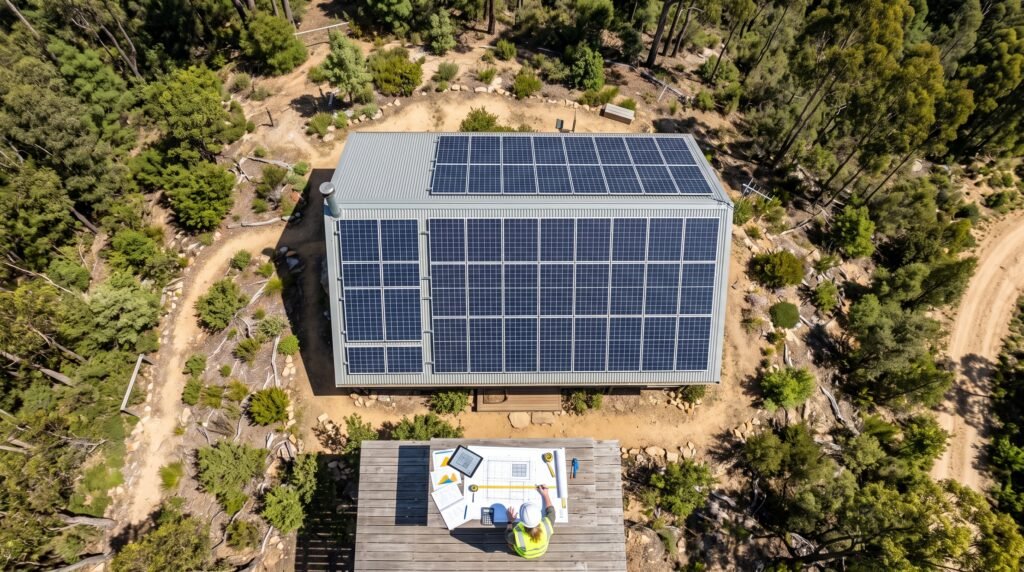
Now you can calculate how much solar capacity you need.
The Formula
Solar Array Size (W) = Adjusted Daily Energy (Wh) ÷ (Peak Sun Hours × System Efficiency)
Peak Sun Hours (PSH) = how many hours per day your location gets strong sunlight (not total daylight).
Peak Sun Hours by Region
| Region/Season | PSH Value | Best Mounting Strategy |
|---|---|---|
| Sunny Southwest (Arizona, Southern California) | 5.5-6.5 PSH | Fixed 20-30° angle all year |
| Moderate (Colorado, Northern California, Ontario) | 4-5 PSH | Seasonal adjustment helps |
| Cloudy (Pacific Northwest, Atlantic Canada) | 3-4 PSH | Conservative sizing essential |
| Winter adjustment (all regions) | -30 to -40{176fcca6730a93a81d392d3d2de5285aaf114f6257de59f55b47dc4f356ad4a2} | Most regions lose 30-40{176fcca6730a93a81d392d3d2de5285aaf114f6257de59f55b47dc4f356ad4a2} in winter |
Real Example: 25 kWh/Day Off-Grid Home in Colorado
- Adjusted daily energy: 19.2 kWh (from Step 2)
- Peak sun hours: 4.5 (Colorado year-round average)
- System efficiency: 0.75
Solar Array = 19.2 kWh ÷ (4.5 × 0.75)
Solar Array = 19.2 ÷ 3.375
Solar Array ≈ 5.7 kW
Add Safety Margin
Most professionals add 10-25{176fcca6730a93a81d392d3d2de5285aaf114f6257de59f55b47dc4f356ad4a2} extra capacity:
5.7 kW × 1.15 = 6.5 kW recommended
Install 6.5 kW of solar panels (about 12-13 panels at 550W each).
How Many Panels?
6,500 watts ÷ 550 watts per panel = 11.8 panels
→ Install 12 panels at 550W each = 6.6 kW
Each panel takes ~2.5 m², so 12 panels need ~30 m² of roof/ground space.
Step 4: Determine Battery Autonomy Days
Autonomy days = how many consecutive days your system can run without ANY solar charging.
This is critical for off-grid reliability.
Autonomy Day Guidelines
| Autonomy Days | Best For | Real-World Impact |
|---|---|---|
| 2 days | Sunny, predictable climates only | Risky; you’ll ration power |
| 3 days | Standard recommendation | Covers most weather patterns |
| 5 days | Remote, unreliable locations | Peace of mind; high reliability |
| 7+ days | Extreme climates (mountains, far north) | Maximum security |
How Autonomy Affects Battery Size
Battery Capacity = Daily Energy × Autonomy Days ÷ (DoD × Efficiency)
Example for 14.4 kWh/day with 3-day autonomy:
Battery = 14.4 × 3 ÷ (0.85 × 0.95) = 53.5 kWh needed
This shows why autonomy days matter: 2 days = 35 kWh battery. 5 days = 88 kWh battery. Massive difference in cost.
Step 5: Calculate Battery Capacity
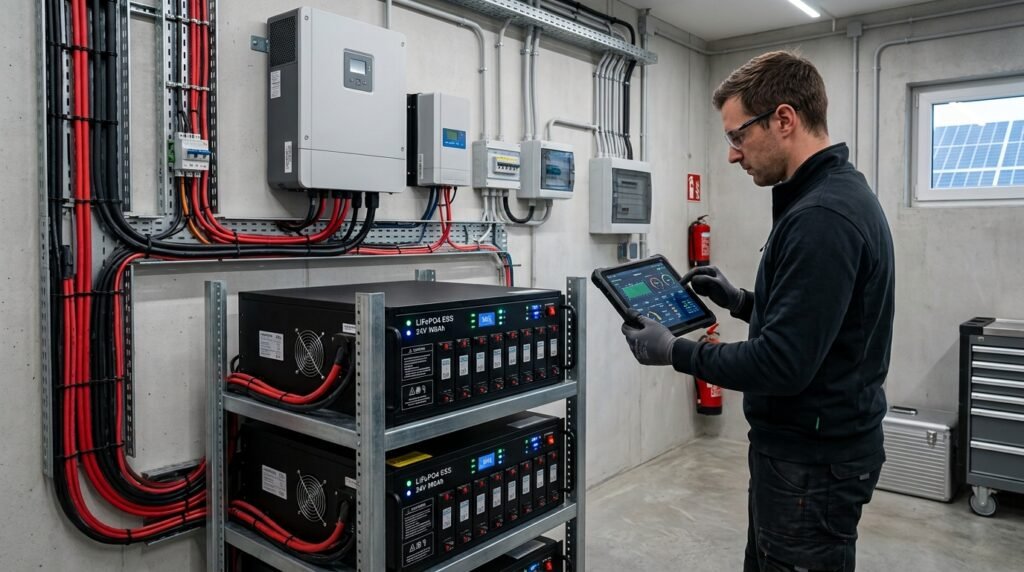
Now for the battery bank – the most expensive component of off-grid systems.
The Complete Formula
Battery Capacity (kWh) = Daily Energy (kWh) × Autonomy Days ÷ (Depth of Discharge × Efficiency)
Lithium LiFePO4 Batteries
Specifications:
- Depth of Discharge: 80-90{176fcca6730a93a81d392d3d2de5285aaf114f6257de59f55b47dc4f356ad4a2} (use 0.85)
- Efficiency: 95{176fcca6730a93a81d392d3d2de5285aaf114f6257de59f55b47dc4f356ad4a2}
- Lifespan: 10-15 years
- Cost: $2,000-$2,500 per kWh
Lead-Acid Batteries
Specifications:
- Depth of Discharge: 50{176fcca6730a93a81d392d3d2de5285aaf114f6257de59f55b47dc4f356ad4a2} (use 0.50)
- Efficiency: 80-85{176fcca6730a93a81d392d3d2de5285aaf114f6257de59f55b47dc4f356ad4a2} (use 0.82)
- Lifespan: 3-7 years
- Cost: $300-$600 per kWh
Real Example: Lithium for 14.4 kWh/Day Home
Assumptions:
- Daily use: 14.4 kWh
- Autonomy: 3 days
- Battery type: Lithium LiFePO4
Battery Capacity = 14.4 × 3 ÷ (0.85 × 0.95)
Battery Capacity = 43.2 ÷ 0.8075
Battery Capacity ≈ 53.5 kWh
Install 55 kWh of lithium batteries
Cost estimate: 55 kWh × $2,200/kWh = $121,000
Lithium vs Lead-Acid Cost Comparison
| Factor | Lithium | Lead-Acid |
|---|---|---|
| Upfront cost (50 kWh) | $110,000 | $25,000 |
| Lifespan | 12 years | 5 years |
| Replacements in 20 years | 1.67 × | 4 × |
| Total 20-year cost | $184,000 | $100,000+ |
| Maintenance | None | Monthly water checks |
| Efficiency | 95{176fcca6730a93a81d392d3d2de5285aaf114f6257de59f55b47dc4f356ad4a2} | 82{176fcca6730a93a81d392d3d2de5285aaf114f6257de59f55b47dc4f356ad4a2} |
| Usable capacity (50{176fcca6730a93a81d392d3d2de5285aaf114f6257de59f55b47dc4f356ad4a2} DoD lead-acid) | 50 kWh usable | 25 kWh usable |
Long-term, lithium is cheaper per year. Short-term, lead-acid is cheaper upfront.
Step 6: Choose System Voltage
System voltage is your electrical “backbone” – it connects panels, batteries, controller, and inverter.
Voltage Options
| Voltage | Best For | Pros | Cons |
|---|---|---|---|
| 12V | Small RVs, vans (< 1 kW) | Cheapest components | High current = cable losses |
| 24V | Medium cabins (1-5 kW) | Moderate efficiency | Limited scalability |
| 48V | Full homes, farms (5+ kW) | Best efficiency, most flexible | Pricier components |
Why Higher Voltage Is Better
Higher voltage = lower current = less energy loss in wiring.
Example for a 5 kW load:
12V system: 5,000W ÷ 12V = 416A → massive cables, high loss
24V system: 5,000W ÷ 24V = 208A → medium cables, moderate loss
48V system: 5,000W ÷ 48V = 104A → thin cables, minimal loss
Energy loss in 100-meter cable run:
- 12V system: 15-20{176fcca6730a93a81d392d3d2de5285aaf114f6257de59f55b47dc4f356ad4a2} loss (unacceptable)
- 24V system: 8-12{176fcca6730a93a81d392d3d2de5285aaf114f6257de59f55b47dc4f356ad4a2} loss (acceptable)
- 48V system: 2-5{176fcca6730a93a81d392d3d2de5285aaf114f6257de59f55b47dc4f356ad4a2} loss (excellent)
For any system over 5 kW, use 48V. The efficiency gains pay for the higher component cost in 3-5 years.
Step 7: Size Charge Controller & Inverter
Two critical components that must match your panel and battery sizes.
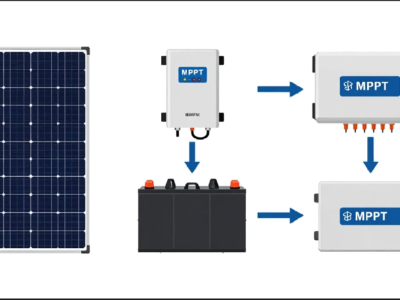
Charge Controller Sizing
Formula:
Controller Current (Amps) = Total Panel Power (W) ÷ System Voltage
Example for 6.5 kW panels at 48V:
Controller Amps = 6,500 ÷ 48 = 135 Amps
Install a 150A MPPT charge controller (add 10{176fcca6730a93a81d392d3d2de5285aaf114f6257de59f55b47dc4f356ad4a2} headroom).
MPPT vs PWM:
- MPPT: 30-40{176fcca6730a93a81d392d3d2de5285aaf114f6257de59f55b47dc4f356ad4a2} more efficient, costs $800-$1,500 (worth it)
- PWM: Simpler, costs $300-$600 (only for < 2 kW systems)
Inverter Sizing
Formula:
Inverter Size = Peak Load × 1.25 Safety Factor
Example: Your peak simultaneous load is 4 kW (AC compressor starting + water heater + lights)
Inverter Size = 4,000 × 1.25 = 5,000W
Install a 5,000W pure sine wave inverter (never modified sine wave – damages sensitive electronics).
Common Sizing Mistakes & How to Avoid Them
Mistake #1: Undersizing Panels for Winter ❌
The error: You calculate daily consumption as 12 kWh/day using summer-weighted average.
Why it fails: Winter sun is 30-40{176fcca6730a93a81d392d3d2de5285aaf114f6257de59f55b47dc4f356ad4a2} weaker. Panels that charge fine in July won’t cut it in January. Batteries stay at 30{176fcca6730a93a81d392d3d2de5285aaf114f6257de59f55b47dc4f356ad4a2} charge all winter = constant rationing.
✅ Fix: Always size for worst-case month (usually December). Your summer system will have excess capacity – that’s fine.
Mistake #2: Ignoring Depth of Discharge ❌
The error: You buy 50 kWh of lead-acid batteries and discharge them to 0{176fcca6730a93a81d392d3d2de5285aaf114f6257de59f55b47dc4f356ad4a2} regularly.
Why it fails: Lead-acid at 50{176fcca6730a93a81d392d3d2de5285aaf114f6257de59f55b47dc4f356ad4a2} DoD lasts 5 years. At 80{176fcca6730a93a81d392d3d2de5285aaf114f6257de59f55b47dc4f356ad4a2} DoD (what you’re doing), it lasts 2 years. By year 4, you need replacements.
✅ Fix: Lithium at 85{176fcca6730a93a81d392d3d2de5285aaf114f6257de59f55b47dc4f356ad4a2} DoD = 12-year lifespan. Lead-acid at 50{176fcca6730a93a81d392d3d2de5285aaf114f6257de59f55b47dc4f356ad4a2} DoD = 5-year lifespan. Plan accordingly.
Mistake #3: Undersized Inverter ❌
The error: Your peak load is 3 kW (AC compressor + heater). You install a 3 kW inverter to save money.
Why it fails: Any appliance starting slightly higher = inverter trips offline. System is down for 2-5 minutes. Happens 10+ times/day.
✅ Fix: Inverter Size = Peak Load × 1.25. For 3 kW peak, use 3.75-4 kW inverter. $200 more upfront saves stress for 20 years.
Mistake #4: Wrong System Voltage for Your Size ❌
The error: You build a 10 kW system at 24V to save component costs.
Why it fails: 10,000W ÷ 24V = 417 Amps. Your cables are massive ($3,000+). Voltage drops 2-3V under load. Inverter shuts down at 42V battery instead of 45V.
✅ Fix: Use 48V for anything over 5 kW. Component cost is $2,000 higher but cable/efficiency savings recover it in 2-3 years.
Mistake #5: Not Planning for Future Expansion ❌
The error: You size exactly for current needs with no headroom.
Why it fails: 2 years later you add an AC unit. Panels can’t handle it. Batteries stay low. System is undersized.
✅ Fix: Add 15-20{176fcca6730a93a81d392d3d2de5285aaf114f6257de59f55b47dc4f356ad4a2} headroom at design time. Cheap now, expensive to retrofit later.
Mistake #6: Forgetting System Losses ❌
The error: You calculate needing 10 kWh/day so you size 10 kWh ÷ 5 hours = 2 kW panels.
Why it fails: With 25{176fcca6730a93a81d392d3d2de5285aaf114f6257de59f55b47dc4f356ad4a2} system losses, your panels actually deliver only 1.5 kW of usable energy. You’re 33{176fcca6730a93a81d392d3d2de5285aaf114f6257de59f55b47dc4f356ad4a2} undersized.
✅ Fix: Divide by efficiency (0.75, not 1.0). True requirement: 10 ÷ (5 × 0.75) = 2.67 kW panels.
Quick Sizing Tool
Rather than manual calculations, use our free calculator to verify your numbers.
Access the OffGridCalc Sizing Tool →
What it does:
- Pulls real solar data for your location
- Calculates adjusted daily consumption
- Recommends panel count (by module wattage)
- Calculates battery capacity (lithium vs lead-acid)
- Suggests charge controller and inverter size
- Estimates total system cost
- Generates a downloadable PDF
Takes 3 minutes. No signup. Works offline.
FAQ: Off-Grid Solar Sizing
Q1: How many solar panels do I actually need for an off-grid home?
A: Depends on:
- Your daily energy consumption
- Your location’s peak sun hours
- Your desired reliability (autonomy days)
Typical answer: 8-12 kW of panels for a 15 kWh/day home in moderate sunlight. Use our calculator to get your exact number.
Q2: What’s the most important number in off-grid sizing?
A: Your daily energy consumption. Everything else flows from it. Get this wrong and all downstream calculations are wrong.
Spend time here. Measure. Calculate. Verify.
Q3: Can I expand my system later?
A: Yes, but only if you chose 48V and oversized your charge controller/inverter.
- Add more panels: Easy (just run more cables)
- Add more batteries: Easy (just parallel more strings)
- Upgrade from 24V to 48V: Hard and expensive (rewire everything)
Plan for expansion at design time.
Q4: Should I oversize my battery bank “just to be safe”?
A: No. Oversizing by 50{176fcca6730a93a81d392d3d2de5285aaf114f6257de59f55b47dc4f356ad4a2}+ wastes money and degrades efficiency.
The sweet spot: Design for worst-case + 15-20{176fcca6730a93a81d392d3d2de5285aaf114f6257de59f55b47dc4f356ad4a2} buffer.
Example: Need 50 kWh → install 55-60 kWh (not 75 kWh)
Q5: Do I need professional engineering to size my system?
A: Our calculator gets you 90{176fcca6730a93a81d392d3d2de5285aaf114f6257de59f55b47dc4f356ad4a2} of the way there. A professional engineer adds the final 10{176fcca6730a93a81d392d3d2de5285aaf114f6257de59f55b47dc4f356ad4a2}:
- Confirms location-specific solar data
- Assesses shade and microclimate
- Reviews building codes and permitting
- Cost: $300-$500
Worth it for a $50K+ system.
Q6: How do seasons affect off-grid sizing?
A: Dramatically. Winter has 30-50{176fcca6730a93a81d392d3d2de5285aaf114f6257de59f55b47dc4f356ad4a2} less sunlight than summer.
Solution: Size your entire system for worst-case winter. Summer will have excess solar, which charges batteries and runs appliances comfortably.
Q7: Should I size for 2-day or 3-day autonomy?
A: Depends:
- 2 days: Only if you’re in a predictable, sunny climate (Arizona, southern California). Not recommended.
- 3 days: Standard. Covers 90{176fcca6730a93a81d392d3d2de5285aaf114f6257de59f55b47dc4f356ad4a2} of weather patterns.
- 5+ days: Remote locations with unpredictable weather.
More autonomy = bigger batteries = higher cost. Find the sweet spot for your situation.
Q8: What’s the difference between on-grid and off-grid sizing?
A: On-grid systems can be undersized slightly because you have grid backup. Off-grid systems must be sized conservatively because you have zero backup. Off-grid systems typically need 15-25{176fcca6730a93a81d392d3d2de5285aaf114f6257de59f55b47dc4f356ad4a2} larger batteries.
For More FAQs VISIT HERE
Conclusion & Next Steps
You now understand how professional engineers size off-grid solar systems.
The formula is simple:
- Calculate real daily consumption (add 20{176fcca6730a93a81d392d3d2de5285aaf114f6257de59f55b47dc4f356ad4a2} buffer)
- Account for 25{176fcca6730a93a81d392d3d2de5285aaf114f6257de59f55b47dc4f356ad4a2} system losses
- Divide by your location’s peak sun hours
- Size panels with 10-25{176fcca6730a93a81d392d3d2de5285aaf114f6257de59f55b47dc4f356ad4a2} safety margin
- Choose autonomy days (3 recommended)
- Calculate battery capacity using DoD and efficiency
- Select 48V for systems over 5 kW
- Size charge controller and inverter
This isn’t guesswork. This is engineering.
Your Next Steps
Option 1: Use our calculator
- Access OffGridCalc
- Input your data
- Get instant sizing recommendations
- Download PDF for your installer
Option 2: Deep dive into specifics
- RV Solar Sizing Guide (if you’re mobile)
- Battery Capacity Deep Dive (focus on batteries)
- Peak Sun Hours by Location (location data)
Option 3: Get professional help
- Contact a certified solar installer
- Have them review your calculator output
- Build your system with confidence
Related Articles on Off-Grid Solar Sizing
- Off-Grid Solar System Design Tool: Complete Sizing & Installation Guide – Full design walkthrough with examples
- How to Calculate Solar Needs for Home – Energy consumption calculations (homeowner-focused)
- Home Solar Battery Calculator 2026 – Battery sizing deep dive with cost analysis
- Optimal Solar Panel Tilt Angle Canada – Angle optimization for your region
- Off-Grid Solar System Cost 2026 – Complete ROI and budget breakdown
Summary: Off-Grid Sizing Formulas (Quick Reference)
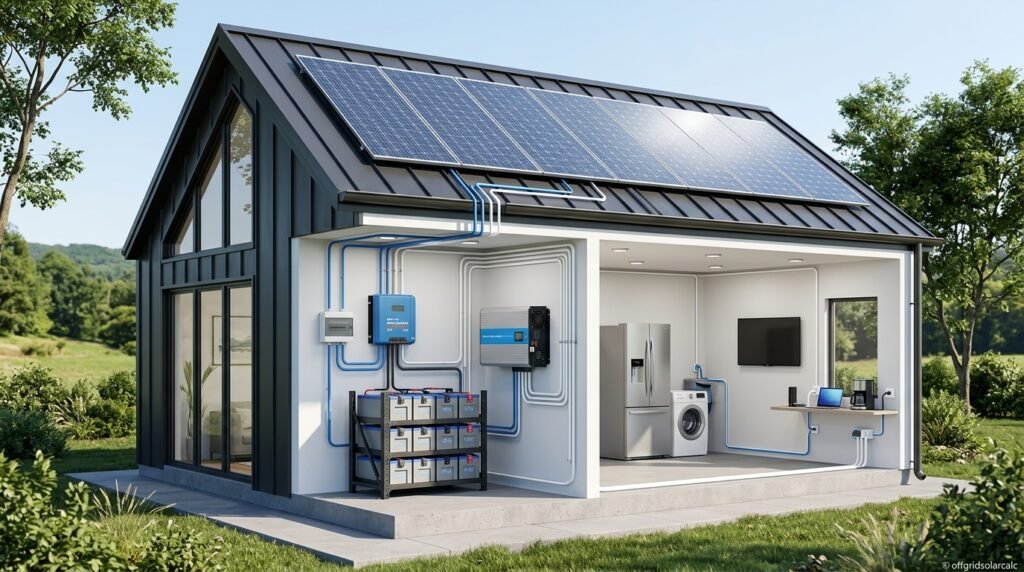
1. DAILY ENERGY = Consumption × 1.2 (add 20{176fcca6730a93a81d392d3d2de5285aaf114f6257de59f55b47dc4f356ad4a2} buffer)

2. ADJUSTED ENERGY = Daily Energy ÷ 0.75 (account for losses)

3. SOLAR ARRAY = Adjusted Energy ÷ (Peak Sun Hours × 0.75)
   → Add 15-25{176fcca6730a93a81d392d3d2de5285aaf114f6257de59f55b47dc4f356ad4a2} safety margin

4. NUMBER OF PANELS = Solar Array ÷ Watts Per Panel

5. BATTERY CAPACITY = Daily Energy × Autonomy Days ÷ (DoD × Efficiency)
   → Lithium: Use 0.85 DoD × 0.95 efficiency
   → Lead-acid: Use 0.50 DoD × 0.82 efficiency

6. SYSTEM VOLTAGE = Use 48V for systems over 5 kW

7. CHARGE CONTROLLER = Panel Watts ÷ System Voltage (in Amps)
   → Add 10-15{176fcca6730a93a81d392d3d2de5285aaf114f6257de59f55b47dc4f356ad4a2} headroom

8. INVERTER SIZE = Peak Load × 1.25 (safety factor)
Print this. Bookmark it. Reference it or you can VISIT HERE to get more solutions and formulas.
Contact: contact@offgridsolarcalc.com
© 2026 OffGridCalc. All rights reserved.
Disclaimer: This article is for educational purposes. Before installing any solar system, consult a certified solar professional, verify local electrical codes, and obtain proper permits and insurance.