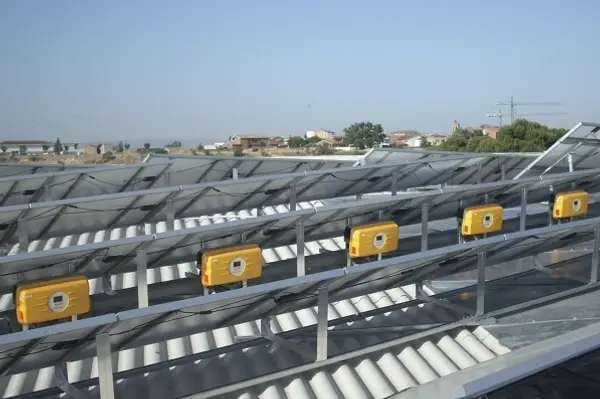
Featured photo: Naval Special Warfare support technicians inspecting an expeditionary photovoltaic solar-powered refrigeration unit operating in the field. U.S. Navy photograph by MC2 William S. Parker; public domain. Resized and converted to WebP.
How Many Solar Panels to Run a Refrigerator? (24/7 Off-Grid Sizing Guide)
⏱️ 12 min read (2,505 words)
🛡️ Fact-Checked: NEC 2026 & Sandia Standards
📖 Sources & References
Advertisement
✍️ By PK Basnet 📅 October 21, 2026 🏷️ Categories: Cabin & Tiny Home, Solar System Sizing ✓ Sourced & Verified Standard
⚡ Direct Answer: How Many Solar Panels to Run a Refrigerator 24/7?
To determine how many solar panels to run a refrigerator continuously 24/7 off-grid, you need between 1 to 4 solar panels (300W to 1,600W total array) depending on whether you operate a dedicated 12V DC compressor fridge or a standard 120V AC residential kitchen refrigerator:
Standard Residential Refrigerator (18–22 cu. ft. Energy Star, 1.2 to 1.8 kWh/day): Requires 3 to 4 panels of 400W (1,200W to 1,600W array), paired with a 200Ah 12V or 100Ah 48V LiFePO4 battery (2.5 to 5.1 kWh storage) and a 1,200W to 2,000W Pure Sine Wave Inverter capable of handling the 1,000W+ inductive compressor startup surge.
Compact / Dorm Refrigerator (4–6 cu. ft., 600 to 900 Wh/day): Requires 2 panels of 300W–400W (600W to 800W array), a 100Ah 12V LiFePO4 battery (1.28 kWh), and an 800W–1,000W inverter.
12V/24V DC Portable / RV Compressor Fridge (45–75 Liters, 350 to 550 Wh/day): Requires 1 to 2 panels of 200W–300W (200W to 400W array) and a 100Ah 12V LiFePO4 battery, completely bypassing the inverter and eliminating tare idle losses.
The 24/7 Autonomy Rule: Solar panels produce zero energy for 14 to 16 hours every night. Because food safety mandates keeping perishables below 40°F (4.4°C) without interruption, your battery storage bank is equally critical as your solar panel wattage. Never size your array solely from the manufacturer’s nominal running watts.
Keeping fresh food cold and insulin safely chilled is the single most critical baseline load in any off-grid cabin, campervan, or homestead power system. It is also the appliance that catches beginner solar builders by surprise more than any other.
The trap lies in looking at the yellow EnergyGuide tag on the back of a modern kitchen refrigerator. The label proudly boasts: *”Estimated Yearly Electricity Use: 450 kWh”*—which works out to a seemingly modest 1,230 watt-hours (1.23 kWh) per day, or an average continuous draw of just 51 watts. Armed with that math, new builders frequently assume a single 200-watt solar panel and a cheap car battery will keep their ice cream frozen.
Two days later, they are greeted by a beeping fault code on an overheated inverter, a dead battery bank sitting at 9.8 volts, and hundreds of dollars of spoiled groceries.
Calculating how many solar panels to run a refrigerator reliably requires looking beyond simple averages. You must account for compressor duty cycles, the hidden electricity devoured by automatic defrost heating elements, the instantaneous 1,200-watt inductive motor startup surge (Locked Rotor Amps), and the silent parasitic tare draw of an inverter running 24 hours a day. Here is the exact electrical engineering formula, equipment sizing matrix, and real-world calculation guide to run your refrigerator 24/7 on solar power without ever risking spoiled food.
1. Refrigerator Sizing Matrix: Refrigerator Types vs. Daily Solar & Battery Requirements
The table below provides field-verified electrical specifications across the three common categories of off-grid refrigeration: compact 12V DC expedition coolers, medium compact mini-fridges, and full-sized 120V AC Energy Star residential units:
Compact Mini-Fridge (4.5 – 6.0 cu. ft. / 120V AC Single Door)
70W – 100W
500W – 800W
650 – 950 Wh/day
600W – 800W (2x 350W–400W)
12V 100Ah – 150Ah (1.3 – 1.9 kWh)
800W – 1,000W (Pure Sine Wave)
Standard Residential Fridge (18 – 22 cu. ft. Energy Star Top/Bottom)
100W – 180W
1,000W – 1,500W
1,200 – 1,800 Wh/day
1,200W – 1,600W (3x to 4x 400W)
12V 200Ah or 48V 100Ah (2.5 – 5.1 kWh)
1,500W – 2,000W (2,000W–3,000W Surge)
Large French Door / Side-by-Side (24 – 28 cu. ft. Dual Evaporator / Ice Maker)
150W – 250W
1,200W – 1,800W
1,800 – 2,600 Wh/day
1,600W – 2,400W (4x to 6x 400W)
48V 100Ah – 150Ah (5.1 – 7.6 kWh)
2,000W – 3,000W (4,000W Peak Surge)
*Assumptions: Solar array figures assume an average of 4.0 Peak Sun Hours (PSH) with an industry-standard 80% (0.80) combined derate factor for wiring drop, panel thermal degradation, and MPPT conversion losses. Battery figures assume lithium iron phosphate (LiFePO4) at an 80% Depth of Discharge (DoD) to provide a minimum of 24 to 36 hours of continuous zero-sun autonomy.
Verified Hardware Standards Direct Amazon Link
Recommended 100Ah LiFePO4 Battery & Solar Recharging Pair
To achieve reliable deep-cycle runtime and eliminate cold-weather lithium plating hazards, pair a low-temperature protected LiFePO4 battery bank with matched portable solar input:
Super Empower 12.8V 100Ah LiFePO4 Deep Cycle Battery
Engineered for RV, marine, and off-grid cabin storage. Delivers 1,280Wh of usable capacity, a continuous 100A internal BMS, integrated low-temperature charge cutoff protection, and support for up to 4S4P bank expansion (up to 20.48 kWh).
High-efficiency monocrystalline solar array designed for rapid off-grid recharging. Features adjustable kickstands for optimal solar angles, rugged IP65 weatherproofing, and multi-adapter outputs compatible with portable stations and 12V LiFePO4 charge controllers.
2. The Electrical Physics of Refrigerator Power: Running Watts vs. Duty Cycle vs. Inrush Surge
To understand how many solar panels to run a refrigerator, you must understand how a vapor-compression refrigerator physically draws electrical current. Unlike a light bulb or an electric kettle that draws a constant, predictable wattage whenever it is energized, a refrigerator operates as a pulsed cyclical load:
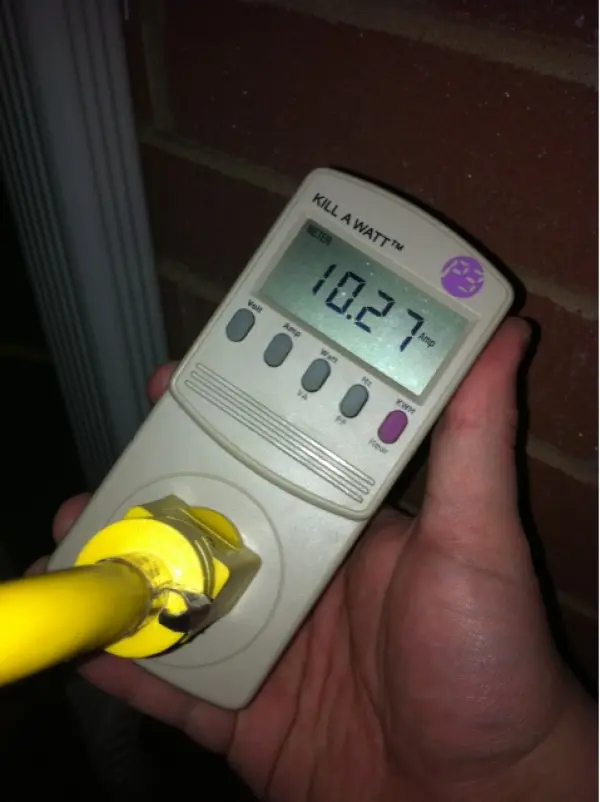
Digital plug-in Kill-A-Watt electrical diagnostic instrument measuring continuous current draw and cumulative kilowatt-hour energy consumption from domestic appliances. Photo by Porkrind on Wikimedia Commons, licensed under CC BY-SA 3.0. Resized and converted to WebP; shared under the same license.
1. Compressor Running Watts & Duty Cycle (30% to 50%)
When the internal thermostat detects that temperatures inside the fresh food compartment have risen above 38°F (3.3°C), the hermetic compressor motor clicks on. On a modern 20 cu. ft. Energy Star refrigerator, the compressor pulls approximately 100 to 140 watts of AC power while actively circulating refrigerant through the sealed lines.
However, the compressor does not run 100% of the time. In an ambient 70°F (21°C) room with good door seals and minimal door openings, the compressor operates on a 33% to 45% duty cycle (roughly 20 minutes running, followed by 30 to 40 minutes sitting completely silent). During the off-cycle, the refrigerator consumes only 1 to 3 watts to power its internal digital control board and sensors.
2. The Destructive Inductive Starting Surge (Locked Rotor Amps)
Here is the primary reason off-grid inverters fail to start refrigerators: an electric motor at a standstill has zero back-electromotive force (back-EMF). For the first 100 to 300 milliseconds when the motor windings are energized, the compressor pulls its Locked Rotor Amps (LRA):
A refrigerator that consumes only 120 watts while running routinely pulls 1,000 to 1,400 watts during the split-second of motor startup (a 6x to 10x multiplier).
If you connect that refrigerator to a cheap 600-watt modified sine wave inverter, the momentary voltage sag will trigger the inverter’s overload protection circuit, tripping the system offline and leaving the compressor stalled. Stalled compressor motors rapidly overheat because they cannot establish rotation.
3. The Hidden Energy Thief: The Automatic Defrost Heater
Virtually all modern residential frost-free refrigerators incorporate an internal electric resistive defrost element. Every 8 to 12 hours of compressor run time, a defrost timer activates a high-wattage heating coil (typically rated at 400 to 650 watts) wrapped directly around the evaporator coils for 20 to 30 minutes to melt accumulating ice.
During that half-hour defrost cycle, your solar battery bank suddenly faces a massive, continuous resistive load that dwarfs normal compressor operation. Over a 24-hour period, the defrost cycle accounts for nearly 25% to 35% of the refrigerator’s entire daily energy footprint!
3. 12V DC Compressor vs. 120V AC Household Fridges: The Inverter Tare Loss Reality
When engineering an off-grid cabin, campervan, or tiny home, one of the biggest architectural decisions is whether to invest in a dedicated 12V/24V DC compressor refrigerator (such as BougeRV, Dometic, or Iceco) or run a standard 120V AC domestic refrigerator through an off-grid inverter:
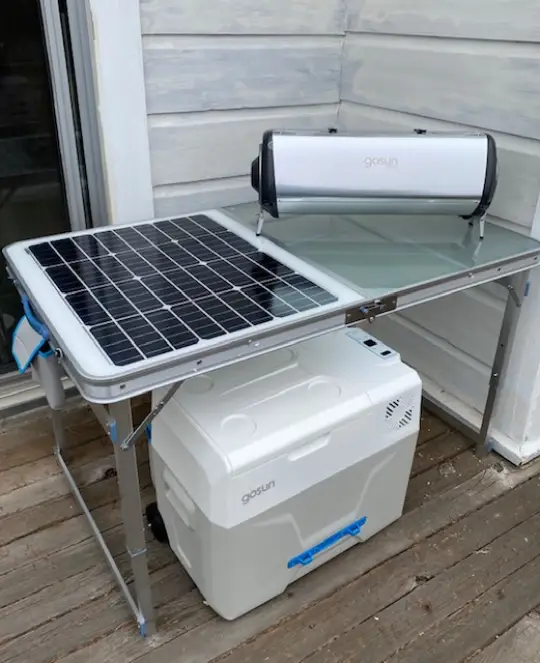
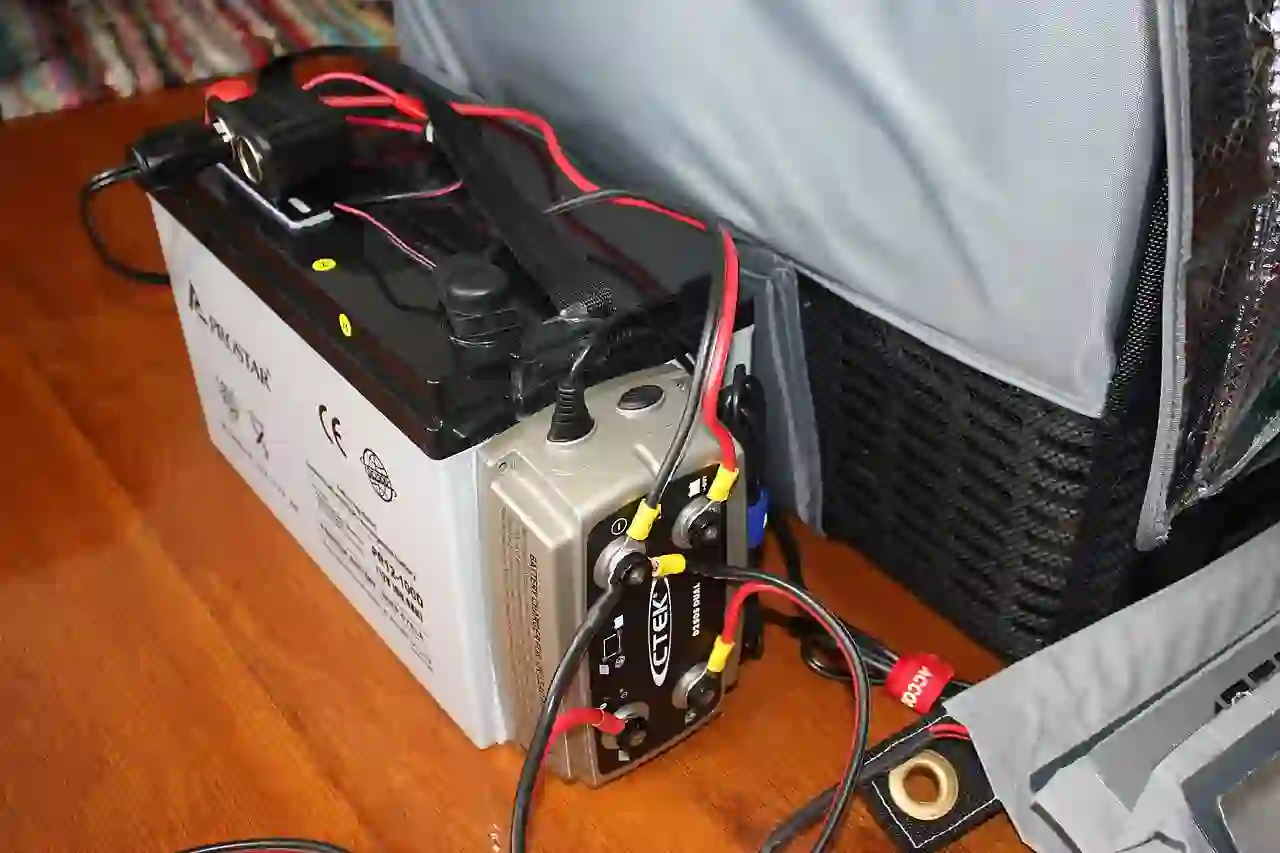
Portable 12V DC electric cooler and refrigeration unit connected directly to an off-grid battery and auxiliary solar generation table. Photo by Energypeg on Wikimedia Commons, licensed under CC BY-SA 4.0. Resized and converted to WebP; shared under the same license.
The Silent Parasite: Inverter Tare (Idle) Consumption
A residential 120V AC refrigerator requires an inverter that remains energized 24 hours a day, 365 days a year. Even when the refrigerator compressor is sitting idle and drawing 0 watts, the inverter’s internal toroidal transformers, cooling fans, and microprocessor control boards consume continuous power—known as tare loss or idle consumption:
A quality 2,000-watt 12V or 48V pure sine wave inverter draws roughly 20 to 35 watts simply being turned on.
$25 Watts \times 24 Hours = 600 Watt-hours (0.6 kWh) per day$ of phantom energy wasted as heat!
On a 12V battery bank, that 600Wh idle loss alone drains 50 amp-hours out of your battery every single day before a single cubic inch of milk has even been cooled.
Why Native 12V/24V DC Refrigerators Win in Compact Systems
A purpose-built 12V or 24V DC refrigerator utilizes a variable-speed brushless DC compressor (such as Secop/Danfoss or LG compressors) wired directly to your battery busbar:
Zero Inverter Requirement: No inverter needs to remain switched on, saving 400Wh to 700Wh of phantom idle energy daily. (For evaluating battery voltage architectures, explore our guide on 12V vs 24V vs 48V battery voltage efficiency).
Soft-Start Electronics: Modern brushless DC compressors ramp up rotational speed gradually over 5 to 10 seconds, completely eliminating the violent 1,000W+ inductive startup spike.
System Efficiency: Because DC fridges avoid the 10% to 15% conversion penalty of inverting DC battery power into AC, a 65-liter 12V DC fridge consumes only 350 to 450 Wh per day—meaning a single 200W or 300W solar panel can power it indefinitely through summer months!
4. Calculating Solar Array & Battery Sizing: Step-by-Step Mathematical Derivation
To size your solar system accurately, let us work through a real-world engineering calculation for a standard 18 cu. ft. Energy Star residential refrigerator consuming 1,400 Wh (1.4 kWh) per day in a typical off-grid cabin environment:
Modern residential kitchen equipped with an energy-efficient refrigerator in an ultra-low-energy off-grid home. U.S. Department of Energy Solar Decathlon photograph by Joe Simon; public domain. Resized and converted to WebP.
Step 1: Calculate Gross Daily Energy Consumption
We must combine the refrigerator’s measured energy demand with the inverter’s idle tare consumption and AC conversion efficiency (assume 90% inverter efficiency and a 20W inverter idle draw):
Step 2: Calculate Required Solar Panel Array Wattage
To harvest 2,035 Wh of gross energy during daylight hours, we divide by local Peak Sun Hours (assume an average of 4.0 PSH in spring/autumn) and apply the mandatory 0.80 real-world solar derate factor (accounting for panel dust, thermal derating, wiring voltage drop, and MPPT conversion losses):
Minimum Solar Array Wattage (STC) = Gross Daily Wh ÷ (Peak Sun Hours × System Efficiency Factor) Minimum Solar Array Wattage (STC) = 2,035 Wh ÷ (4.0 PSH × 0.80) = 2,035 ÷ 3.2 = 636 Watts
While 636 watts is the theoretical mathematical minimum, off-grid systems must tolerate consecutive cloudy days and seasonal winter sun drops. In practice, installing two 400-watt panels (800W) or three 400-watt panels (1,200W) provides the vital safety margin needed to fully recharge the battery bank before sunset. (To evaluate how battery storage chemistry affects off-grid autonomy, see our guide on choosing the best batteries for continuous off-grid storage).
Step 3: Size the LiFePO4 Battery Storage Bank
A refrigerator runs all night. To guarantee 2 days of autonomy (48 hours of operation) during storm fronts without sun, your battery must store at least $2,035 Wh \times 2 = 4,070 Wh$ of usable energy:
Lithium Iron Phosphate (LiFePO4) at 80% DoD: $4,070 Wh \div 0.80 = 5,088 Wh (5.1 kWh)$. On a 48V nominal battery bank (51.2V), this equals exactly one standard 48V 100Ah server-rack battery module (5,120 Wh).
Traditional Lead-Acid (AGM/Gel) at 50% DoD: $4,070 Wh \div 0.50 = 8,140 Wh (8.1 kWh)$. You would require four massive 12V 200Ah deep-cycle AGM batteries weighing over 500 lbs to safely provide the identical usable runtime!
5. Common Sizing Traps That Leave Food Spoiled
Field service technicians frequently diagnose ruined compressors and dead batteries caused by basic planning oversights. Ensure your setup avoids these four dangerous pitfalls:
Trap 1: Using a Modified Sine Wave Inverter
Never attempt to run a modern refrigerator on a cheap modified sine wave (square wave) inverter. The harsh harmonic distortion produces extreme inductive heating in the compressor’s copper stator windings, causing the motor to run 20°C to 30°C hotter than designed. Over several weeks, the excess thermal stress breaks down winding insulation, triggering an internal short circuit that permanently destroys the compressor. Always install a verified Pure Sine Wave (Total Harmonic Distortion < 3%) inverter.
Trap 2: Placing the Refrigerator in an Unconditioned Garage or Porch
In hot summer weather, moving a refrigerator into an uninsulated cabin shed or sunroom where ambient temperatures reach 95°F (35°C) causes its compressor duty cycle to jump from 35% to 75% or 80%. The refrigerator’s daily energy consumption will literally double from 1.4 kWh/day to 2.8 kWh/day, rapidly bankrupting an undersized solar array. Keep your refrigerator in the coolest, most well-ventilated portion of your living quarters.
If your cabin is located in northern climates and left unheated during winter weekends, cold temperatures alter both refrigerator performance and battery charging. While the cold cabin reduces refrigerator compressor run times, freezing temperatures prevent your LiFePO4 battery bank from accepting charge current without risking permanent lithium plating damage, as detailed in our guide on safe LiFePO4 battery cold weather limits. For comprehensive whole-cabin electrical planning, consult our master guide on complete off-grid cabin solar system planning.
Advertisement
📚
Technical References & Authoritative Sources
Our technical guides are cross-referenced against authoritative electrical standards, government energy research institutions, and certified hardware specifications. Explore the core reference publications behind our calculations below. For full documentation, visit our Sources & References Directory, NEC Solar Code Directory, and Calculation Methodology.
🛰️ European Commission PVGIS DatabasePhotovoltaic Geographical Information System. Satellite solar irradiance and peak sun hours (PSH) models for precise geographical sizing.
🔬 NREL (National Renewable Energy Laboratory)PVWatts Calculator & U.S. Dept. of Energy models for solar derate factors, temperature coefficients, and system loss estimation.
🏛️ Sandia National LaboratoriesStand-Alone Photovoltaic System Simulation & Loss-of-Load Probability (LOLP) algorithms (SAND87-2379 / OSTI ID: 6207302).
📑 IRS Residential Clean Energy Credit (Form 5695)Section 25D provides a 30% federal clean energy tax credit for qualifying off-grid solar and battery storage systems (3+ kWh capacity) placed in service through 2032.
Educational Content Creator & Renewable Energy Researcher
PK Basnet is an educational content creator and independent researcher behind OffGridSolarCalc. Passionate about clean energy education, he synthesizes publicly available electrical guidelines (NEC/NFPA 70), climatological datasets (NREL PVWatts), and manufacturer specifications into transparent planning calculators and practical educational guides for homeowners, cabin planners, and students.
📖Educational Standards & Research Methodology:
Every guide and calculation tool on this site is developed under a disciplined educational framework: mathematical Loss-of-Load Probability (LOLP) modeling formulated by Sandia National Laboratories (Report SAND87-2379), NREL string derating factors, code-grounded principles (NEC Articles 690, 705 & 706), empirical insolation data (EU PVGIS-ERA5), manufacturer engineering datasheet cross-referencing, and public errata tracking. Our tools illustrate preliminary sizing math for educational planning and do not replace professional installation review by a licensed electrical contractor.