Introduction
Designing an off-grid solar system used to feel like rocket science – or worse, something that required hiring an expensive consultant.
When I first started researching solar power for remote homes and cabins, I discovered a frustrating pattern: most guides were either too technical (full of engineering jargon you’d never use) or dangerously oversimplified (missing critical details that cost thousands later).
Here’s what I learned the hard way: A small sizing mistake can leave you powerless on cloudy days or force you to spend an extra $10,000 on equipment you didn’t need. Undersizing batteries? You lose power at night. Undersizing panels? Batteries never fully charge. Undersizing the inverter? Your fridge shuts the system down.
That’s why I decided to break down the exact engineering logic that professional solar installers use – and explain it without the jargon. Whether you’re planning a cabin, RV, farmhouse, tiny home, or a full off-grid house, this guide walks you through every formula, every calculation, and every decision you need to make.
And if math isn’t your thing? I built OffGridCalc – a completely free, privacy-first design tool that does these calculations automatically, with no sign-up required.
Use the free OffGridCalc solar system designer to run these calculations for your specific location — completely free, works offline, and no sign-up required.
What Is an Off-Grid Solar System Design Tool?
An off-grid solar system design tool is a calculator that helps you figure out exactly how much solar panel capacity, battery storage, and inverter power you need to run your home, cabin, or vehicle independently from the utility grid.
Think of it as a translator between “I use about 5,000 watt-hours per day” and “You need 7 kW of solar panels, 20 kWh of batteries, and a 3,000W inverter.”
Why You Can’t Just Guess
Unlike grid-tied solar (where you feed extra power to the grid and get credited), off-grid systems must be perfectly balanced:
- Panels too small? Batteries never fully charge → power shortages at night
- Batteries too small? You run out of stored energy on cloudy days
- Inverter too weak? Your fridge or washing machine triggers a shutdown
- System losses ignored? Real-world systems lose 15–30{176fcca6730a93a81d392d3d2de5285aaf114f6257de59f55b47dc4f356ad4a2} of energy to wiring, heat, and inefficiencies
One bad calculation = thousands in wasted money or years of power rationing.
This is why proper sizing isn’t optional – it’s foundational.
Step 1: Calculate Your Daily Energy Consumption (Wh per Day)
The foundation of any solar design is your actual daily energy use. Not a guess. Not an estimate. Real numbers.
Start by listing every appliance you plan to run, its power rating (watts), and how many hours per day you use it.
The Formula
Daily Energy (Wh) = Power (W) × Hours Used × Quantity
Example
- LED lights: 200W × 5 hours = 1,000 Wh
- Refrigerator: 150W × 10 hours = 1,500 Wh
- Laptop: 60W × 6 hours = 360 Wh
- Water pump: 800W × 1 hour = 800 Wh
Total daily energy ≈ 3,660 Wh (3.66 kWh)
Real-World Example: A Mountain Cabin
| Appliance | Watts | Hours/Day | Daily Use (Wh) |
|---|---|---|---|
| LED lights (4 × 10W bulbs) | 40W | 5 hours | 200 Wh |
| Refrigerator | 150W | 10 hours | 1,500 Wh |
| Laptop/charging | 60W | 6 hours | 360 Wh |
| Water pump | 800W | 1 hour | 800 Wh |
| Washing machine (weekly avg) | 500W | 1.5 hours | 750 Wh |
| Space heater (winter only) | 1,500W | 4 hours | 6,000 Wh |
| Miscellaneous (fans, outlets) | – | – | 500 Wh |
| TOTAL DAILY | – | – | ~10,110 Wh |
So this cabin needs ~10 kWh per day to operate comfortably.
This number is the starting point for every other calculation.
Pro Tips for Accurate Calculations
✅ Measure actual usage, not nameplate ratings. Your fridge might say 600W but actually draws 150W average.
✅ Include everything, including battery chargers, phantom loads, and devices you haven’t thought of yet.
✅ Add a 20{176fcca6730a93a81d392d3d2de5285aaf114f6257de59f55b47dc4f356ad4a2} safety buffer. Real-world usage is almost always higher than estimates.
✅ Separate seasonal loads (space heaters, window ACs). Winter and summer might need different system sizes.
Your daily energy consumption is the single most important number in solar design. Everything else flows from it.
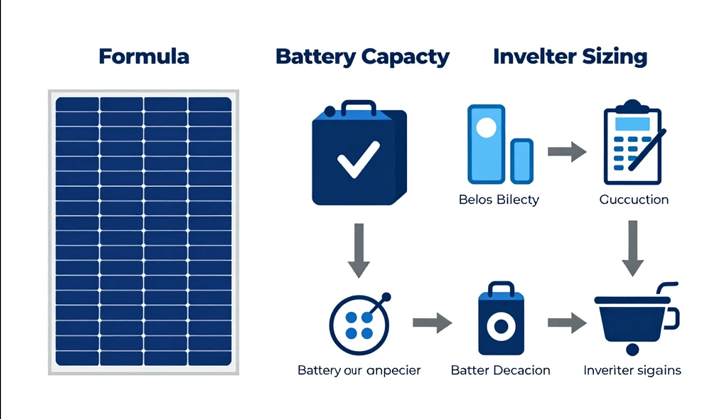
Step 2: Solar Panel Array Sizing (kWp)
Now that you know your daily energy needs, you can calculate how much solar panel capacity you need.
The key variable here is Peak Sun Hours (PSH) – the average number of hours per day when sunlight is strong enough for full panel output. This varies dramatically by location and season.
- Sunny locations (Arizona, Southern California): 5–6 PSH
- Moderate locations (Colorado, Northern California): 4–5 PSH
- Cloudy locations (Pacific Northwest, Canada): 3–4 PSH
- Winter reductions: Most locations lose 40–60{176fcca6730a93a81d392d3d2de5285aaf114f6257de59f55b47dc4f356ad4a2} of summer PSH in winter
The Panel Sizing Formula
Solar Array Size (W) = Daily Energy (Wh) ÷ (Peak Sun Hours × System Efficiency)
System Efficiency Accounts For:
- Wiring losses (2–3{176fcca6730a93a81d392d3d2de5285aaf114f6257de59f55b47dc4f356ad4a2})
- Dust and dirt (5–15{176fcca6730a93a81d392d3d2de5285aaf114f6257de59f55b47dc4f356ad4a2})
- Temperature derating (5–10{176fcca6730a93a81d392d3d2de5285aaf114f6257de59f55b47dc4f356ad4a2})
- Charge controller efficiency (5–10{176fcca6730a93a81d392d3d2de5285aaf114f6257de59f55b47dc4f356ad4a2})
- Total typical efficiency: 0.70–0.85 (use 0.75 for conservative sizing)
Real-World Example: The Mountain Cabin
- Daily energy needed: 10,000 Wh
- Peak sun hours: 4.5 hours (mountain location, year-round average)
- System efficiency: 0.75
Solar Array Size = 10,000 ÷ (4.5 × 0.75)
Solar Array Size = 10,000 ÷ 3.375
Solar Array Size ≈ 2,963 W ≈ 3 kW
Recommendation: 3–4 kW of solar panels (about 7–10 panels at 400W each)
Adding a Safety Margin
Most professionals add 10–25{176fcca6730a93a81d392d3d2de5285aaf114f6257de59f55b47dc4f356ad4a2} extra capacity to account for future growth, seasonal losses, and unexpected needs.
For the cabin: 3 kW × 1.2 = 3.6 kW recommended
This means 9 × 400W panels or 10 × 350W panels.
Step 3: Battery Bank Sizing for Autonomy Days
Batteries are where the magic happens – they let you use solar power at night and survive cloudy days. But undersizing batteries is one of the most expensive mistakes people make.
Key Concept: Autonomy Days
Autonomy days = How many consecutive days your system can run without any solar charging.
- 2 days: Minimum backup (only for sunny climates)
- 3 days: Standard recommendation (handles most weather)
- 5 days: High reliability (peace of mind for remote locations)
- 7+ days: Maximum safety (for extreme climates like mountains or far north)
The Battery Sizing Formula
Battery Capacity (kWh) = Daily Energy (kWh) × Autonomy Days ÷ (Depth of Discharge × Battery Efficiency)
What’s Depth of Discharge (DoD)?
DoD is the percentage of battery capacity you can safely use before recharging. Discharging below this limit damages batteries.
- Lithium (LiFePO4): 80–90{176fcca6730a93a81d392d3d2de5285aaf114f6257de59f55b47dc4f356ad4a2} DoD (use 0.85)
- Lead-acid: 50{176fcca6730a93a81d392d3d2de5285aaf114f6257de59f55b47dc4f356ad4a2} DoD (use 0.50)
- Older lithium: 70{176fcca6730a93a81d392d3d2de5285aaf114f6257de59f55b47dc4f356ad4a2} DoD (check specs)
Battery Efficiency:
- Lithium: ~95{176fcca6730a93a81d392d3d2de5285aaf114f6257de59f55b47dc4f356ad4a2} (minimal losses)
- Lead-acid: ~80–85{176fcca6730a93a81d392d3d2de5285aaf114f6257de59f55b47dc4f356ad4a2} (heat losses during charge/discharge)
Real Example: The Mountain Cabin with Lithium
Assumptions:
- Daily energy: 10 kWh
- Autonomy: 3 days
- Battery type: Lithium LiFePO4
- DoD: 0.85
- Efficiency: 0.95
Battery Capacity = 10 × 3 ÷ (0.85 × 0.95)
Battery Capacity = 30 ÷ 0.8075
Battery Capacity ≈ 37.1 kWh
Recommendation: 40 kWh of lithium battery storage
This is a substantial investment ($20,000–$30,000+), but it ensures:
- Three full days of power without sun
- Gentle charging/discharging (extends battery life to 12–15 years)
- Consistent voltage under load
- Reliable operation in all weather
Lithium vs. Lead-Acid Trade-Off
| Factor | Lithium | Lead-Acid |
|---|---|---|
| Upfront Cost | $2,000–$2,500/kWh | $300–$600/kWh |
| Usable Capacity (80{176fcca6730a93a81d392d3d2de5285aaf114f6257de59f55b47dc4f356ad4a2} DoD) | 32 kWh usable | 20 kWh usable |
| Lifespan | 10–15 years | 3–7 years |
| Maintenance | None | Regular (flooded) |
| Cost Per Year | ~$150–200 | ~$500–1,000+ |
| Best For | Long-term systems | Budget-conscious, short-term |
For a 10-year+ system, lithium is cheaper per year despite higher upfront cost.
Step 4: Inverter Sizing (Continuous and Surge Power)
The inverter is your system’s “power converter” – it transforms DC power from batteries into AC power for your appliances. It’s also the hardest-working component, so sizing it correctly prevents shutdowns and failures.
Two Critical Inverter Ratings
- Continuous Power: How much load the inverter can handle all day long
- Surge/Peak Power: How much instantaneous power it can deliver for 5–10 seconds
Most appliances draw 5–10× their running wattage when starting.
The Inverter Sizing Formula
Inverter Size = Peak Load × 1.25 Safety Factor
Real Example: Identifying Peak Load
List your heaviest simultaneous loads:
| Appliance | Watts |
|---|---|
| Refrigerator (starting) | 800W |
| Electric water heater | 4,500W |
| Washing machine (starting) | 2,200W |
| Microwave | 1,200W |
| Realistic Peak Load | 1,500W |
(You rarely run everything at once. Estimate realistic simultaneous use.)
Inverter Size = 1,500 × 1.25 = 1,875 W
Recommendation: 2,500W pure sine wave inverter
This provides:
- Enough capacity for your peak load (1,500W + margin)
- Room for future appliances
- Protection against surges
- Compatibility with sensitive electronics
Pure Sine Wave vs. Modified Sine Wave
- Pure Sine Wave: Best quality, works with all appliances, slightly more expensive
- Modified Sine Wave: Budget option, can damage sensitive electronics (laptops, medical devices)
Use pure sine wave for any modern home. Period.
Step 5: Select System Voltage
System voltage is the “backbone” that connects panels, batteries, charge controller, and inverter. Choosing correctly affects efficiency, safety, and cost.
Voltage Options & Best Applications
| System Voltage | Best Use Case | Efficiency | Cost | Scalability |
|---|---|---|---|---|
| 12V | Small RVs, vans, tiny cabins (< 1 kW) | Lower (higher current) | Lowest | Limited |
| 24V | Medium cabins, small homes (1–5 kW) | Medium | Medium | Moderate |
| 48V | Full homes, farms (5–20+ kW) | Highest (lower current) | Moderate–High | Excellent |
Why Voltage Matters: The Physics
Higher voltage = lower current = less heat loss in wiring
Example for a 5 kW load:
- 12V system: 400A current → massive cables, high losses
- 24V system: 200A current → medium cables, moderate losses
- 48V system: 100A current → thin cables, minimal losses
For any system over 3 kW, use 48V. The efficiency gains pay for themselves in 3–5 years through lower component costs and better performance.
Choosing the Right System Voltage (12V, 24V, or 48V)
System voltage affects efficiency, cable size, and scalability.
| System Voltage | Best Use Case |
|---|---|
| 12V | Small RVs, vans, tiny cabins |
| 24V | Medium cabins and small homes |
| 48V | Full homes and large systems |
Higher voltage means lower current, less heat, and better efficiency. Most modern off-grid homes use 48V systems.
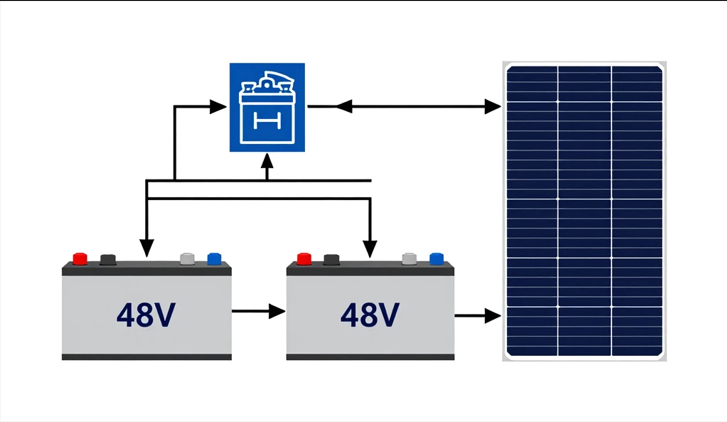
Battery Configuration: Series & Parallel
Once you know your battery capacity (kWh) and voltage (48V), you need to understand how to wire batteries together.
Series Connection (Increases Voltage)
Batteries connected in series add their voltages:
- 4 × 12V batteries in series = 48V
- 2 × 24V batteries in series = 48V
Parallel Connection (Increases Capacity)
Batteries in parallel add their amp-hours (Ah):
- 2 × 100Ah batteries in parallel = 200Ah
- 3 × 100Ah batteries in parallel = 300Ah
Real Example: Building a 48V, 40 kWh System
Option 1: Using 12V Lithium Modules
- 4 × 12V batteries in series = 48V
- Repeat this “string” 5 times in parallel = 5 × (4 modules) = 20 modules total
- Each module: 2 kWh
- Total: 20 × 2 = 40 kWh at 48V ✓
Option 2: Using 48V Pre-assembled Battery Packs
- 5 × LiFePO4 48V/100Ah packs = 5 × 4.8 kWh = 24 kWh
- Add 2 more = 7 packs = 33.6 kWh
- Add 1 more small pack = 40 kWh at 48V ✓
Most homeowners use Option 2 (pre-assembled packs) because it’s simpler and safer.uirements.
Common Design Mistakes & How to Avoid Them
I’ve seen thousands of off-grid installations. The failures almost never come from bad equipment – they come from bad design.
Mistake #1: Undersizing Solar Panels ⚠️
What happens: Batteries never fully charge on winter days. System gradually degrades.
Real example: A cabin owner calculated needing 2 kW but installed 1.5 kW to save money. In winter, batteries dropped to 20{176fcca6730a93a81d392d3d2de5285aaf114f6257de59f55b47dc4f356ad4a2} by afternoon and stayed there. After 3 years, the battery lifespan was cut by 60{176fcca6730a93a81d392d3d2de5285aaf114f6257de59f55b47dc4f356ad4a2} (3 years vs. 10).
How to avoid it:
- Always size for winter (not summer average)
- Add 20–25{176fcca6730a93a81d392d3d2de5285aaf114f6257de59f55b47dc4f356ad4a2} safety margin
- Use real peak sun hours for your location
- Account for system losses (don’t ignore the 0.75 efficiency factor)
Cost impact: Adding 500W more panels = $400. Replacing batteries early = $15,000.
Mistake #2: Undersizing Battery Bank ⚠️
What happens: You lose power at night or during 2–3 cloudy days. Forced rationing of appliances.
Real example: A family on the coast calculated needing 25 kWh but installed 15 kWh to save money. Coastal weather brings 3–4 cloudy days regularly. They were constantly managing power, running the backup generator, and stressed about every cloudy day.
How to avoid it:
- Use 3+ days autonomy (not 2)
- Use 85{176fcca6730a93a81d392d3d2de5285aaf114f6257de59f55b47dc4f356ad4a2}+ DoD for lithium (don’t try to squeeze extra from 50{176fcca6730a93a81d392d3d2de5285aaf114f6257de59f55b47dc4f356ad4a2} DoD)
- Account for battery efficiency losses
- Size for realistic peak usage days (not average)
Cost impact: Adding 10 kWh of battery = $25,000 upfront. Living with constant power anxiety = priceless stress cost.
Mistake #3: Ignoring Depth of Discharge (DoD) ⚠️
What happens: Batteries fail in 3–4 years instead of 10–15 years.
Real example: A DIY builder used 50 kWh of lead-acid batteries but regularly discharged them to 20{176fcca6730a93a81d392d3d2de5285aaf114f6257de59f55b47dc4f356ad4a2} (80{176fcca6730a93a81d392d3d2de5285aaf114f6257de59f55b47dc4f356ad4a2} DoD). Lead-acid is designed for 50{176fcca6730a93a81d392d3d2de5285aaf114f6257de59f55b47dc4f356ad4a2} DoD. After 2.5 years, batteries were dead. He learned that lead-acid at 80{176fcca6730a93a81d392d3d2de5285aaf114f6257de59f55b47dc4f356ad4a2} DoD lasts ~2 years, not 5.
How to avoid it:
- Know your battery’s rated DoD
- Lithium: 80–90{176fcca6730a93a81d392d3d2de5285aaf114f6257de59f55b47dc4f356ad4a2} is safe
- Lead-acid: 50{176fcca6730a93a81d392d3d2de5285aaf114f6257de59f55b47dc4f356ad4a2} is absolute maximum
- Calculate usable capacity correctly:
- 40 kWh lithium at 85{176fcca6730a93a81d392d3d2de5285aaf114f6257de59f55b47dc4f356ad4a2} DoD = 34 kWh usable
- 40 kWh lead-acid at 50{176fcca6730a93a81d392d3d2de5285aaf114f6257de59f55b47dc4f356ad4a2} DoD = 20 kWh usable
Mistake #4: Undersizing the Inverter ⚠️
What happens: Appliances cause shutdowns. Inverter gets damaged from repeated overloads.
Real example: A tiny home owner estimated peak load at 1,500W and installed a 1,500W inverter (no margin). When the washing machine and water heater ran simultaneously (2,000W), the inverter shut down repeatedly. After 18 months, it failed completely.
How to avoid it:
- Always add 1.25× safety factor
- List all realistic simultaneous loads
- Test worst-case scenarios (What if fridge + heater + laptop all start at once?)
- Pure sine wave only (modified sine wave causes issues)
Mistake #5: Ignoring System Losses ⚠️
What happens: You calculate everything correctly but the real system underperforms by 15–30{176fcca6730a93a81d392d3d2de5285aaf114f6257de59f55b47dc4f356ad4a2}.
Real example: A designer calculated needing 2.5 kW of panels assuming 0.9 efficiency. Real efficiency was 0.70 (due to dust, temperature, wiring losses). On a sunny day, the system still underperformed. Batteries never fully charged.
How to avoid it:
- Use 0.75 or lower for system efficiency (conservative)
- Account for:
- Dust and dirt (5–15{176fcca6730a93a81d392d3d2de5285aaf114f6257de59f55b47dc4f356ad4a2} loss)
- Temperature derating (hot panels lose efficiency)
- Wiring losses (2–3{176fcca6730a93a81d392d3d2de5285aaf114f6257de59f55b47dc4f356ad4a2})
- Charge controller inefficiency (5–10{176fcca6730a93a81d392d3d2de5285aaf114f6257de59f55b47dc4f356ad4a2})
- Inverter losses (3–5{176fcca6730a93a81d392d3d2de5285aaf114f6257de59f55b47dc4f356ad4a2})
Mistake #6: Oversizing Without a Plan ⚠️
What happens: You spend $50,000 on a system you don’t need.
Real example: A family of 2 planning a retirement home calculated needing 5 kWh daily but installed a 15 kWh system with 8 kW of panels “for future growth.” Ten years later, they still use 5 kWh daily. The excess system will never pay for itself.
How to avoid it:
- Size for current needs + realistic 20{176fcca6730a93a81d392d3d2de5285aaf114f6257de59f55b47dc4f356ad4a2} growth buffer
- Plan for expandability (don’t just overshoot capacity)
- Understand your true lifestyle before finalizing size
Complete Example: Designing a Real Cabin System {#example}
Let me walk you through a real design from start to finish.
The Scenario
You’re building a mountain cabin:
- Location: Colorado Rockies (4.5 peak sun hours average, year-round)
- Usage: Weekend retreat + occasional week-long stays
- Goals: Comfortable living, no rationing, minimal noise/environmental impact
Step 1: Calculate Energy Consumption
After measuring similar cabins in the area, you estimate:
Daily Energy Use:
- Lights (12 hours × 4 bulbs × 10W): 480 Wh
- Refrigerator (24h × 150W avg): 3,600 Wh
- Water pump (2 hours × 800W): 1,600 Wh
- Laptop/entertainment (4 hours × 200W): 800 Wh
- Space heater (winter, 4 hours × 1,500W): 6,000 Wh (seasonal)
- Miscellaneous: 500 Wh

Summer total: ~7 kWh/day
Winter total: ~13 kWh/day
Use winter (13 kWh) for sizing panels and batteries.
Step 2: Size Solar Panels
For winter operation in Colorado:
Solar Array = 13,000 Wh ÷ (4.5 hours × 0.75 efficiency)
Solar Array = 13,000 ÷ 3.375 = 3,852 W

Add 20{176fcca6730a93a81d392d3d2de5285aaf114f6257de59f55b47dc4f356ad4a2} safety margin: 3,852 × 1.2 = 4,622 W
Recommendation: 5 kW array (12–13 panels at 400W each)
This ensures batteries charge even on partly cloudy winter days.
Step 3: Size Battery Bank
3 days autonomy for winter weather:
Battery Capacity = 13 kWh × 3 ÷ (0.85 DoD × 0.95 efficiency)
Battery Capacity = 39 ÷ 0.8075 = 48 kWh
Recommendation: 50 kWh lithium (LiFePO4) battery bank
Cost estimate: $25,000–$35,000 for quality batteries.
Step 4: Choose Inverter
Realistic peak load: 2,000W (fridge + heater starting + lights + laptop)
Inverter Size = 2,000 × 1.25 = 2,500W
Recommendation: 3,000W pure sine wave inverter (slight upgrade for headroom)
Cost: $1,500–$2,500
Step 5: System Voltage
For 5 kW array and 50 kWh battery, use 48V system (standard for this size).
Complete System Summary
| Component | Size | Estimated Cost |
|---|---|---|
| Solar Panels | 5 kW (12–13 × 400W) | $4,000–$6,000 |
| Battery Bank | 50 kWh lithium | $25,000–$35,000 |
| Inverter | 3,000W pure sine | $1,500–$2,500 |
| Charge Controller | 60A MPPT (48V) | $800–$1,200 |
| Wiring, breakers, safety | – | $1,500–$2,500 |
| Installation (if hired) | – | $3,000–$8,000 |
| TOTAL | – | $36,000–$55,000 |
Prices from 2026; vary by location and brand.
Why Proper Sizing Matters (Critical Section) {#why-sizing-matters}
I want to pause here and be blunt: improper sizing is the #1 reason off-grid systems fail.
Not equipment failure. Not bad weather. Bad design.
The Real Cost of Undersizing
Scenario A: Undersized Panels
- Owner calculates 3 kW needed, installs 2 kW to save $3,000
- Winter comes; batteries never fully charge
- By month 3, batteries are permanently stuck at 50{176fcca6730a93a81d392d3d2de5285aaf114f6257de59f55b47dc4f356ad4a2} charge
- Accelerated battery degradation: 10-year lifespan → 4 years
- Battery replacement cost: $15,000 every 4 years instead of every 10 years
- Real cost: Save $3,000 now, spend $15,000 extra every 4 years
Scenario B: Undersized Batteries
- Owner calculates 30 kWh needed, installs 20 kWh to save $12,000
- System works fine in summer
- Winter clouds arrive; after 2 days, batteries are completely empty
- Forced to run backup generator at $4/hour fuel cost + noise
- Or ration power: no hot water, limited appliances, constant stress
- Real cost: Live uncomfortably OR spend $500–$1,000 monthly on generator fuel
Scenario C: Proper Sizing (Higher Upfront Cost)
- Owner sizes correctly: 5 kW panels, 50 kWh batteries, 3,000W inverter
- System runs flawlessly winter and summer for 10+ years
- Batteries maintain 95{176fcca6730a93a81d392d3d2de5285aaf114f6257de59f55b47dc4f356ad4a2}+ efficiency even after 10 years
- Real cost: Higher upfront ($50K), but zero problems for a decade
Over 20 years, proper sizing is dramatically cheaper.
The Psychological Cost
There’s something I don’t see in spreadsheets but hear constantly from off-grid people: peace of mind.
When your system is sized correctly:
- You don’t stress about cloudy weather
- You don’t ration power
- You don’t worry about batteries dying
- You sleep well knowing you have 3+ days of autonomy
When undersized:
- Cloudy day = anxiety
- Guest arriving = stress (will there be enough power?)
- Battery discharge = constant mental math
- Generator = noise, smell, expense
Sizing properly costs money upfront. Undersizing costs sanity over time.
FAQ: Off-Grid Solar System Design {#faq}
Q1: What is the most important number in off-grid design?
A: Your daily energy consumption in watt-hours (Wh). Everything else – panel size, battery capacity, inverter rating – flows from this single number. If you get this wrong, everything downstream is wrong.
Spend time here. Measure. Calculate. Verify. It’s worth the effort.
Q2: Should I design my system for summer or winter?
A: Always design for winter (or your worst-case month).
Summer design will leave you powerless 6 months of the year. Winter-sized systems work comfortably year-round.
Example:
- Colorado summer: 5.5 PSH
- Colorado winter: 2.5 PSH
Size for 2.5 PSH, and your summer system will have excess capacity (which is fine).
Q3: What’s the difference between “peak sun hours” and “daylight hours”?
A: Peak sun hours (PSH) = hours when sunlight is strong enough for full panel output (typically 9 AM–3 PM).
Daylight hours = total hours of daylight (sunrise to sunset, maybe 14 hours in summer, 10 in winter).
Your panels only produce useful power during PSH. That’s why location and latitude matter so much.
Q4: Can I design an off-grid system myself, or do I need an engineer?
A: You can absolutely design it yourself using the formulas in this guide. Millions of people successfully DIY off-grid systems.
However:
- If doing it yourself, add conservative safety margins (25{176fcca6730a93a81d392d3d2de5285aaf114f6257de59f55b47dc4f356ad4a2}+)
- Have a professional review your design before installation
- Get liability insurance
- Follow local electrical codes
A professional engineer costs $500–$2,000 but catches critical errors. That’s cheap insurance for a $50K+ system.
Q5: How do I know if my battery type is appropriate?
A: Ask three questions:
- How long will I keep the system?
- 5+ years? → Lithium (better ROI long-term)
- <5 years? → Lead-acid (cheaper short-term)
- Can I handle maintenance?
- No → Lithium (zero maintenance)
- Yes → Lead-acid is fine (check water levels monthly)
- What’s my budget flexibility?
- Flexible → Lithium (better long-term value)
- Tight → Lead-acid (lower upfront)
Honest assessment: For most new systems, lithium is the better choice. Lead-acid is mostly for budget-constrained installations or people willing to replace batteries every 3–5 years.
Q6: What’s the most oversized component mistake?
A: Oversizing inverters. People think “bigger is always safer” and install 5,000W inverters for 1,500W loads.
Problem: Oversized inverters:
- Cost more upfront
- Are less efficient at partial loads
- Take up more space
- Encourage future feature creep
Better approach: Size correctly, leave 10–15{176fcca6730a93a81d392d3d2de5285aaf114f6257de59f55b47dc4f356ad4a2} margin. You can always upgrade later if needed.
Q7: Can I expand my system later if I need more power?
A: Yes, but plan for it now by:
- Choosing a system voltage that scales (48V is best)
- Installing an oversized charge controller (room for extra panels)
- Leaving space for additional batteries
- Using modular components (not monolithic blocks)
Cheaper to plan ahead than retrofit later.
Q8: What about seasonality? Should I size for winter or design a hybrid?
A: Three options:
- Winter sizing + summer excess (simplest)
- Size system for winter peak demand
- In summer, excess solar energy goes unused
- Most reliable approach
- Most people choose this
- Hybrid with diesel generator (middle)
- Size system smaller
- Add generator for winter backup
- Fewer batteries, fewer panels
- Noise and fuel costs
- Common in remote areas with harsh winters
- Seasonal battery management (complex)
- Install separate summer/winter battery banks (impractical)
- Not recommended for most people
Recommendation: Go with Option 1 (winter sizing). It’s simpler, quieter, and more reliable.
Q9: How does system efficiency loss affect my calculations?
A: It’s huge. Most beginners forget it.
Without 0.75 efficiency factor:
Solar Array = 10,000 Wh ÷ 4.5 hours = 2,222 W (WRONG)
With 0.75 efficiency factor:
Solar Array = 10,000 Wh ÷ (4.5 × 0.75) = 2,963 W (CORRECT)
That’s a 741W difference. On a cloudy day with real losses, the undersized array won’t charge batteries properly.
Always include efficiency losses. Conservative is safer.
Q10: What’s the most common sizing error you see?
A: People design for average conditions instead of worst-case conditions.
They think:
- “Average winter has 4 PSH” → size for 4 PSH ✗
- “Average month is 15 cloudy days” → design for that ✗
Real logic:
- “Worst winter month has 2.5 PSH” → size for 2.5 PSH ✓
- “Winter can bring 5 consecutive cloudy days” → autonomy of 5+ days ✓
Design for worst-case. Hope for average. Never regret it.
FOR MORE FAQs YOU CAN LOOKUP HERE
Key Components Checklist
A complete off-grid system includes all of these:
- [ ] Solar Panels (PV modules, properly sized kWp)
- [ ] Mounting Structure (roof/ground rails, tilting option)
- [ ] DC Disconnect Switch (safety cutoff between panels and controller)
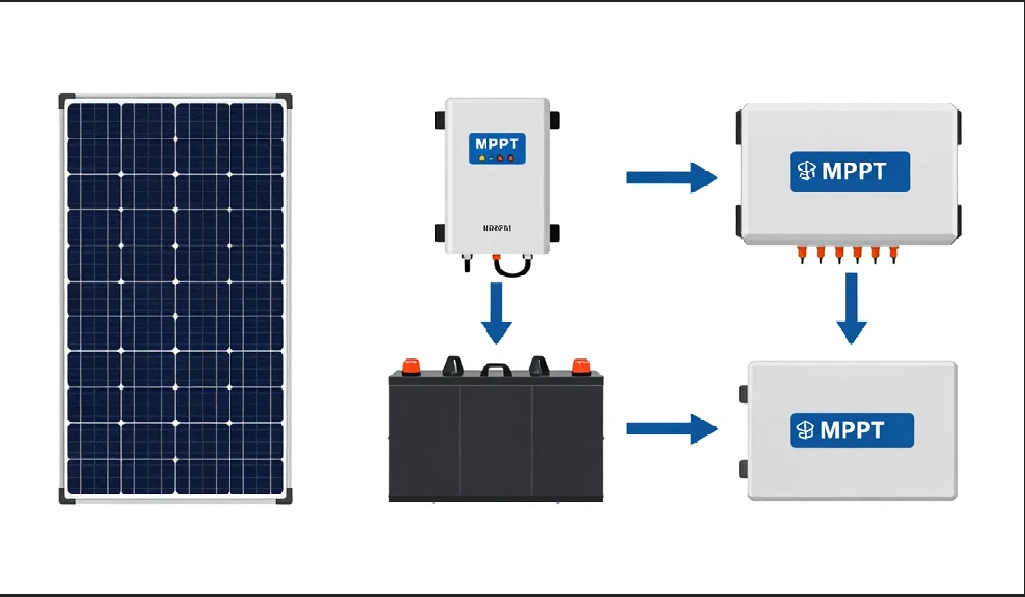
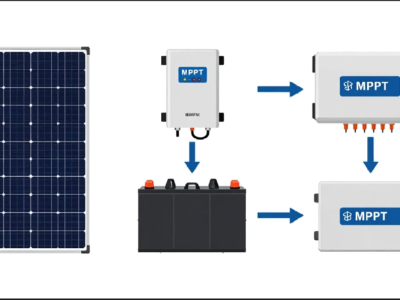
- [ ] MPPT Charge Controller (60–100A, rated for your voltage)
- [ ] Battery Bank (lithium or lead-acid, correct voltage & capacity)
- [ ] Battery Monitoring System (BMS for lithium, or external monitor)
- [ ] Battery Disconnect Switch (safety cutoff for batteries)
- [ ] DC Breaker/Fuses (protection for high-voltage DC circuits)
- [ ] Pure Sine Wave Inverter (correct wattage, voltage output 120/240V)
- [ ] AC Breaker Panel (circuit breakers for AC outlets & appliances)
- [ ] AC Disconnect Switch (safety cutoff for inverter output)
- [ ] Grounding & Earthing System (lightning, safety)
- [ ] Proper Gauge Wiring (don’t undersizing – causes fires!)
- [ ] Fuses & Breakers (correct amperage ratings)
- [ ] Generator (backup for winter or emergency, optional but recommended)
- [ ] Shunt/Battery Monitor (track charge/discharge in real-time)
Conclusion & Next Steps
You now understand the exact engineering logic that professional solar installers use to design off-grid systems.
The formulas work. They’ve been proven by thousands of installations over decades. When you apply them correctly, you get a system that works reliably for 20+ years.
Next: Stop Calculating by Hand
Here’s the truth: calculating by hand is error-prone and tedious.
You can use a spreadsheet, but even small mistakes (wrong efficiency, wrong autonomy days, wrong PSH) ripple through every calculation.
That’s why I built OffGridCalc – a completely free tool that:
✅ Pulls real solar data for your exact location
✅ Calculates panel & battery size automatically
✅ Accounts for all efficiency losses
✅ Generates a PDF system design
✅ Works completely offline
✅ Zero data collection, 100{176fcca6730a93a81d392d3d2de5285aaf114f6257de59f55b47dc4f356ad4a2} private
No email required. No sign-up. No tracking. Just enter your location and energy use, and get professional-grade calculations in 2 minutes.
Then: Get a Professional Review
Once you have your preliminary design from OffGridCalc, I recommend:
- Have a local solar installer review it (usually free consultation)
- Verify your peak sun hours with local weather data
- Confirm component compatibility (battery + inverter + controller)
- Get a written quote before committing money
A professional review costs nothing upfront and catches critical errors that could cost thousands later.
Related Articles You’ll Find Useful
- Off-Grid Solar System Cost 2026: Complete Sizing Guide + Calculator – Full cost breakdown and ROI calculations
- How to Calculate Solar Needs for Home: Step-by-Step Guide – Energy consumption deep dive
- Home Solar Battery Calculator 2026 – Battery-specific sizing tool & guide
- Optimal Solar Panel Tilt Angle Canada 2026 – Maximize output for your location
Summary: Key Formulas for Quick Reference
1. Daily Energy (Wh) = Power (W) × Hours Used

2. Solar Array Size (W) = Daily Energy (Wh) ÷ (PSH × 0.75 Efficiency)

3. Battery Capacity (kWh) = Daily Energy (kWh) × Autonomy Days ÷ (DoD × Battery Efficiency)

4. Inverter Size (W) = Peak Load (W) × 1.25 Safety Factor

5. System Voltage: 48V for homes, 24V for medium cabins, 12V for RVs/vans

For More Formulas you can visit HERE