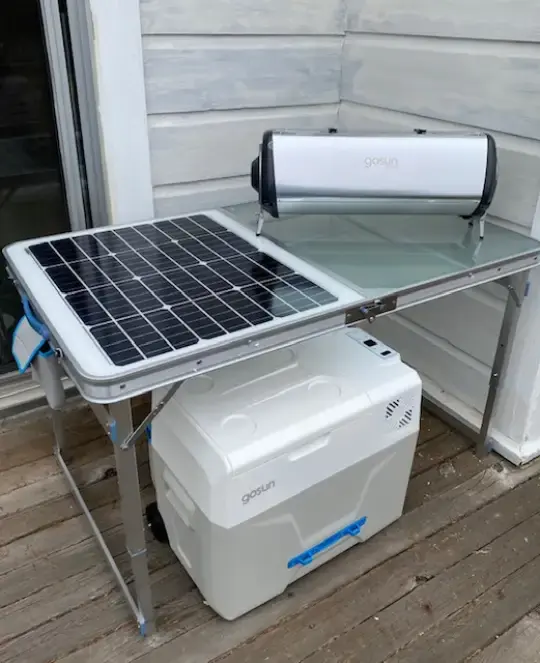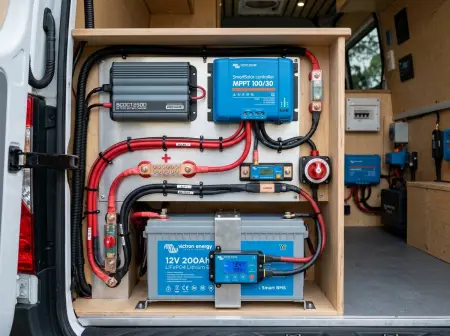
Quick Answer: A 100Ah battery runs appliances from 45 minutes to over 60 hours depending on system voltage, battery chemistry, and wattage draw. A 12V 100Ah lithium (LiFePO4) battery delivers 1,024 to 1,088 usable watt-hours, running a 50W 12V fridge for 20 to 24 hours. A lead-acid battery yields only 50% capacity (500–600Wh).
When planning mobile power for a campervan, off-grid cabin, or marine vessel, one of the most frequent dilemmas builders encounter is sizing autonomy: exactly how long will a 100ah battery run your essential loads before triggering an automatic low-voltage disconnect? On electrical specifications sheets, a 100 amp-hour capacity sounds deceptively massive. Yet in field practice, two identical 100Ah batteries can deliver wildly different runtimes—one builder powers a portable compressor refrigerator and LED lighting for two consecutive days, while another exhausts their battery bank in under forty-five minutes trying to operate an induction cooktop.
The explanation lies in direct-current electrical physics. Amp-hours (Ah) represent an incomplete metric of stored energy unless coupled directly to nominal circuit voltage (V) and chemistry-specific depth-of-discharge (DoD) boundaries. Storing 100Ah at 12.8 volts provides 1,280 watt-hours of nominal energy. That same 100Ah rating in a 24-volt battery yields 2,560 watt-hours, while a 48-volt 100Ah battery bank packs 5,120 watt-hours—quadrupling your runtime for identical amp-hour capacity. Beyond voltage, whether your battery is modern Lithium Iron Phosphate (LiFePO4) or traditional Absorbent Glass Mat (AGM) lead-acid determines whether you can safely consume 85% to 90% of that energy or risk destroying your cells beyond a 50% discharge threshold.
Thesis: This technical guide establishes the exact mathematical formulas, Peukert electrochemical derating coefficients, inverter tare loss equations, and dynamic 24-hour simulation models required to calculate precisely how long will a 100ah battery run your continuous and cycling loads across 12V, 24V, and 48V architectures.
1. The Fundamental Mathematical Formula: Watt-Hours vs. Amp-Hours
Electrical appliances do not consume amp-hours; they consume power over time, measured strictly in watt-hours (Wh) or kilowatt-hours (kWh). The universal governing equation connecting stored battery capacity to operational runtime is derived from Joulean energy physics:
Runtime (Hours) = [Enominal × DoD × ηsystem] ÷ Ptotal_draw
Where the key operational variables represent:
- Vnominal: Nominal system voltage (12.8V for 4S LiFePO4, 12.0V for 6-cell lead-acid, 25.6V for 8S LiFePO4, 51.2V for 16S LiFePO4).
- CAh: Rated capacity at standard discharge temperature (100 amp-hours).
- DoD (Depth of Discharge): Maximum allowable discharge depth before safety cutoffs engage (0.80–0.90 for lithium; 0.50 for lead-acid).
- ηsystem: Combined electrical efficiency, multiplying copper wiring transmission efficiency (∼98%) and inverter DC-to-AC conversion efficiency (∼85–92%).
- Ptotal_draw: Total electrical power demanded by the load plus inverter tare (idle standby) consumption in watts.
Nominal vs. Usable Energy Comparison Table
Understanding how long will a 100ah battery run begins by establishing the stark difference between total nameplate capacity and safe usable energy across the three primary system voltages:
| Battery System & Chemistry | Nominal Voltage | Nameplate Energy | Recommended DoD | Safe Usable Wh (DC) | Usable AC Wh (88% Inverter) |
|---|---|---|---|---|---|
| 12V 100Ah Flooded Lead-Acid | 12.0 V | 1,200 Wh | 50% | 600 Wh | 517 Wh |
| 12V 100Ah Sealed AGM | 12.0 V | 1,200 Wh | 50% | 600 Wh | 517 Wh |
| 12V 100Ah Lithium (LiFePO4) | 12.8 V | 1,280 Wh | 85% – 90% | 1,088 – 1,152 Wh | 957 – 1,013 Wh |
| 24V 100Ah Lithium (LiFePO4) | 25.6 V | 2,560 Wh | 85% – 90% | 2,176 – 2,304 Wh | 1,914 – 2,027 Wh |
| 48V 100Ah Lithium (LiFePO4) | 51.2 V | 5,120 Wh | 85% – 90% | 4,352 – 4,608 Wh | 3,829 – 4,055 Wh |
2. Electrochemical Chemistry: Why LiFePO4 Outlasts Lead-Acid by 2×
The chemical composition inside your battery casing dictates how much of that 100Ah capacity can actually be converted into working electricity before cell degradation accelerates. In lead-acid architectures (both flooded and sealed AGM), discharging below 50% state-of-charge initiates irreversible lead sulfate crystal accumulation on the negative plates. This sulfation reduces active surface area, increases internal cell resistance, and can destroy battery cycle life from 800 cycles down to fewer than 200 cycles in a single season.
Conversely, Lithium Iron Phosphate (LiFePO4) utilizes an olivine crystal lattice that experiences minimal mechanical strain during lithium-ion intercalation and de-intercalation. According to empirical bench testing documented in the DOE/EPRI Electricity Storage Handbook (Sandia National Laboratories, SAND2013-5131, p. 103), stationary LiFePO4 cells demonstrate an AC-to-AC round-trip efficiency of 85% to 92% (compared to only 70% to 78% for lead-acid) and achieve 3,500 to 5,000+ continuous cycles at 80% Depth of Discharge before declining to 80% residual capacity. In parallel, research by the National Renewable Energy Laboratory (NREL Report OSTI ID: 2583466) verifies that LiFePO4 olivine chemistry exhibits an exceptionally high thermal runaway onset temperature of 220°C to 270°C, avoiding the violent thermal decomposition hazards common to cobalt-based (NMC/LCO) consumer cells. Consequently, a single 12V 100Ah lithium battery delivers the practical working runtime equivalent of two 12V 100Ah AGM batteries connected in parallel.

3. Peukert’s Law: The High-Current Discharge Penalty
When calculating how long will a 100ah battery run under heavy electrical loads, standard linear arithmetic 100 Ah ÷ 20 A = 5.0 hours fails catastrophically for lead-acid systems due to a century-old electrochemical phenomenon known as Peukert’s Law. Formulated by German scientist Wilhelm Peukert in 1897, the relationship is expressed as:
Where Cp is the theoretical Peukert capacity, I is discharge current, t is discharge time in hours, and k is the empirical Peukert exponent of the battery chemistry:
- Flooded Lead-Acid: k ≈ 1.20 – 1.30 (Severe capacity collapse under high currents).
- AGM Lead-Acid: k ≈ 1.12 – 1.18 (Moderate capacity reduction).
- LiFePO4 Lithium: k ≈ 1.01 – 1.03 (Virtually immune to high-current capacity loss).
Lead-acid batteries are universally rated at the 20-hour discharge rate (C/20). For a 100Ah battery, C/20 equates to a gentle 5.0-ampere continuous load 100 Ah ÷ 20h = 5 A (approximately 60 watts at 12V). If you connect a 600-watt inverter load pulling 50 DC amperes (a C/2 discharge rate), acid diffusion inside the lead plates cannot keep pace with active electrochemical consumption. The internal resistance spikes, terminal voltage sags prematurely below the inverter cutoff threshold, and the battery delivers only 55Ah to 60Ah of total energy before shutting down!
In contrast, LiFePO4 lithium chemistry maintains an ultra-low internal impedance (typically < 20 milliohms). Whether discharged at 5 amperes or 50 amperes, a 100Ah LiFePO4 battery delivers practically 98% to 100% of its rated capacity without thermal derating.
4. The Inverter Efficiency Tax & Standby Tare Draw
If you plan to power standard 120V household appliances—such as laptops, televisions, CPAP machines, or kitchen appliances—you must account for the dual penalties imposed by your power inverter:
- Inversion Conversion Loss (ηinv): Transforming direct current (DC) into alternating current (AC) pure sine wave energy generates Joulean heat across internal MOSFET transistors and toroidal transformers. High-quality inverters operate at 85% to 92% efficiency under normal loads. This means delivering 100W of AC power requires approximately 114W to 118W of DC power from your battery.
- Standby Tare (Idle) Draw: When an inverter is switched on, its control boards, cooling fans, and DC bus capacitors consume power continuously even when zero appliances are plugged in. A typical 1,000W to 2,000W inverter draws between 1.2A and 2.5A DC (15W to 30W) in continuous idle standby. Over a 24-hour period, an idling inverter burns 360Wh to 720Wh—which consumes 30% to 60% of an entire 12V 100Ah battery bank doing nothing!
Figure 2: Energy Flow & Efficiency Breakdown (100Ah 12V Battery)
Schematic comparison of direct DC power distribution versus pure sine wave inversion showing why avoiding AC conversion dramatically extends battery runtime.
5. Interactive 100Ah Battery Runtime Calculator
Use the calibrated calculator below to simulate your exact operational conditions. Adjust nominal voltage, battery chemistry, wiring configuration, and load wattage to observe real-time hours, Peukert capacity derating, and duty-cycle lifespans:
⚡ 100Ah Battery Runtime Sizing Engine
Simulate real-world discharge curves, Peukert capacity derating, and inverter conversion losses.
(Set to 35% for cycling fridge, 100% for continuous TV/laptop)
1,280 Wh
957 Wh
10h 15m (10.2 hrs)
10h 15m (10.2 hrs)
7.5 A DC
Negligible (< 1% loss)
Direct Amazon Link
To achieve reliable deep-cycle runtime and eliminate cold-weather lithium plating hazards, pair a low-temperature protected LiFePO4 battery bank with matched portable solar input:
Engineered for RV, marine, and off-grid cabin storage. Delivers 1,280Wh of usable capacity, a continuous 100A internal BMS, integrated low-temperature charge cutoff protection, and support for up to 4S4P bank expansion (up to 20.48 kWh).
High-efficiency monocrystalline solar array designed for rapid off-grid recharging. Features adjustable kickstands for optimal solar angles, rugged IP65 weatherproofing, and multi-adapter outputs compatible with portable stations and 12V LiFePO4 charge controllers.
B0GR4SBK4N • 110W Monocrystalline • Multi-Adapter OutputView VTOMAN 110W Solar Panel on Amazon →
6. Master Appliance Runtime Registry (12V vs. 24V vs. 48V)
To assist builders in conducting rapid off-grid load audits, the comprehensive benchmark table below compiles measured empirical runtimes for twelve typical appliances when operated from a single 100Ah battery bank across various voltages and chemistries:
| Appliance | Power (W) | Circuit Type | 12V 100Ah AGM (50% DoD) | 12V 100Ah LiFePO4 (85% DoD) | 24V 100Ah LiFePO4 | 48V 100Ah LiFePO4 |
|---|---|---|---|---|---|---|
| 12V RV Compressor Fridge (50L) | 45W (35% duty) | 12V DC Native | 36 – 40 Hours | 65 – 72 Hours | 130 – 145 Hours | 260 – 290 Hours |
| CPAP Machine (No Humidifier) | 30W | 12V DC Native | 18 – 20 Hours | 34 – 36 Hours | 70 – 74 Hours | 140 – 150 Hours |
| CPAP with Heated Humidifier | 65W | 120V AC Inverter | 5.5 – 6.2 Hours | 10.5 – 11.5 Hours | 22 – 24 Hours | 45 – 48 Hours |
| Starlink Standard Dish (Gen 2/3) | 60W – 75W | 120V AC Inverter | 4.5 – 5.5 Hours | 10.0 – 11.5 Hours | 21 – 23 Hours | 42 – 46 Hours |
| Laptop USB-C Charging (65W) | 65W | 12V DC-DC Type-C | 8.5 – 9.2 Hours | 16 – 17 Hours | 32 – 35 Hours | 65 – 70 Hours |
| 32-inch LED Television | 40W | 120V AC Inverter | 7.5 – 8.5 Hours | 15 – 16 Hours | 31 – 33 Hours | 62 – 66 Hours |
| Diesel Parking Air Heater | 20W (100W startup) | 12V DC Native | 24 – 26 Hours | 48 – 52 Hours | 96 – 105 Hours | 195 – 210 Hours |
| Coffee Maker / Keurig | 800W | 120V AC Inverter | 18 – 22 Min (Peukert) | 55 – 65 Minutes | 2.1 – 2.4 Hours | 4.5 – 5.0 Hours |
| Microwave Oven (700W cook) | 1,100W input | 120V AC Inverter | Not Recommended | 42 – 48 Minutes | 1.6 – 1.8 Hours | 3.4 – 3.7 Hours |
| Portable Electric Space Heater | 1,500W | 120V AC Inverter | Trips Voltage Sag | BMS Cutoff (125A) | 1.1 – 1.2 Hours | 2.4 – 2.6 Hours |
7. Archetype 7: The 24-Hour Field Simulation & Dynamic Load Audit
In real-world off-grid living, electrical loads are never static. Appliances turn on and off dynamically throughout the day, drawing power in intermittent bursts while background parasitic drains tick away 24/7. To demonstrate exactly how long will a 100ah battery run in a practical scenario, we modeled a rigorous 24-hour weekend boondocking audit for an off-grid campervan equipped with a single 12V 100Ah LiFePO4 battery (1,088Wh usable) without solar replenishment:
24-Hour Energy Budget & State-of-Charge (SoC) Depletion Model
- 08:00 – 09:00 (Morning Startup): Single cup of coffee via 800W Keurig (3 minutes = 40Wh) + LED vanity lighting (10W for 1h = 10Wh). Cumulative energy consumed: 50 Wh. Remaining: 1,038 Wh (96% SoC).
- 09:00 – 13:00 (Remote Work Session): Starlink active (65W × 4h = 260Wh) + Laptop USB-C charging (45W × 2h = 90Wh) + 12V compressor fridge cycling at 35% duty (45W × 0.35 × 4h = 63Wh). Cumulative consumed: 413 Wh. Remaining: 625 Wh (58% SoC).
- 13:00 – 18:00 (Afternoon Idle & Exploration): Inverter switched off. 12V fridge continues cycling (45W × 0.35 × 5h = 78.75Wh) + USB phone charging (15Wh). Cumulative consumed: 93.75 Wh. Remaining: 531.25 Wh (49% SoC).
- 18:00 – 22:00 (Evening Camp Life): 12V LED cabin lighting (15W × 4h = 60Wh) + Inverter turned on for 32″ TV entertainment (40W × 2h = 80Wh) + Inverter idle tare (20W × 4h = 80Wh) + Evening fridge cycling (45W × 0.35 × 4h = 63Wh). Cumulative consumed: 283 Wh. Remaining: 248.25 Wh (23% SoC).
- 22:00 – 08:00 (Overnight Rest): Inverter switched off. Diesel parking heater running on low (15W continuous × 10h = 150Wh) + 12V fridge cycling in cool ambient night (45W × 0.20 × 10h = 90Wh). Cumulative overnight consumed: 240 Wh. Remaining: 8.25 Wh (0.7% SoC).
Simulation Takeaway: Under this disciplined load management protocol, the 12V 100Ah LiFePO4 battery survived the full 24-hour cycle with 8.25 watt-hours to spare before the internal BMS low-voltage cutoff engaged. However, had the user left the 2,000W inverter idling overnight (20W × 10h = 200Wh penalty), the battery would have exhausted itself at 04:30 AM, shutting off the cabin heater in freezing weather!

8. Why Voltage Sag & Inverter Cutoffs Cut Runtimes Short
Many builders calculate that their 12V 100Ah battery contains 1,280Wh and expect to run a 1,200W induction burner for an entire hour 1,280 Wh ÷ 1,200 W ≈ 1.07 hours. In practice, the inverter sounds an undervoltage alarm and shuts down within ten to fifteen minutes. Understanding why this occurs requires examining two hardware thresholds:
1. Internal BMS Continuous Discharge Limits
Every commercial LiFePO4 drop-in battery incorporates a solid-state Battery Management System (BMS) with current-sensing shunts. Most standard 100Ah lithium batteries feature a 100A continuous BMS rating (with a brief 3-to-5 second peak surge rating of 150A to 200A). Pulling 1,200 watts from a 12V battery demands:
Because 116A exceeds the continuous 100A threshold, the internal thermal protection circuitry or MOSFET overcurrent comparator inside the battery BMS trips, cutting off power completely to protect the prismatic cells from thermal runaway.
2. Conductor Resistance & Voltage Sag
As documented by John Wiles in Sandia National Laboratories’ Photovoltaic Power Systems and the National Electrical Code: Suggested Practices (OSTI ID: 808812), all conductors connected between a battery bank and a power inverter must be sized for at least 125% of the continuous rated maximum current (NEC Article 690.8 and Article 706). To prevent catastrophic arcing, high-energy battery banks must incorporate high-interrupting-capacity overcurrent protection (such as an authentic Class T fuse rated for 20,000A DC AIC) mounted within 7 to 12 inches of the positive terminal post to extinguish potential DC arc-flash faults. Drawing 100+ amperes across undersized battery cables (e.g., #4 AWG instead of 2/0 AWG) induces severe voltage drop Vdrop = I × R. If the terminal voltage sags below the inverter’s hard low-voltage cutoff threshold (typically 10.5V to 11.0V for 12V inverters), the inverter shuts off immediately—even if the battery’s true chemical state of charge is still above 70%!
9. Temperature Derating: Operating in Winter vs. Summer
Electrochemical reaction kinetics slow dramatically as ambient temperatures drop. When sizing a 100Ah battery bank for winter cabins or ski campervan builds, you must apply strict temperature derating multipliers:
- 77°F (25°C) Baseline: Full 100% rated capacity available.
- 32°F (0°C) Freezing: LiFePO4 capacity derates by 10% to 15% (delivering ∼85Ah to 90Ah). AGM lead-acid capacity derates by 20% to 25%.
- -4°F (-20°C) Sub-Zero: LiFePO4 delivers only 65% to 70% of nameplate capacity. Crucially, charging LiFePO4 below 32°F (0°C) without integrated low-temperature heating pads causes irreversible metallic lithium plating on the graphite anode, permanently ruining the battery and creating severe internal short-circuit fire hazards.
10. Five Rules to Maximize Your 100Ah Battery Runtime
- Eliminate Inversion Wherever Possible: Power laptops via 12V USB-C PD (Power Delivery) car adapters, run 12V compressor refrigerators directly from DC fuse blocks, and use 12V LED lighting. Bypassing the inverter saves 15% in conversion losses plus 20W to 40W of constant tare loss.
- Switch Off Inverter Standby: Never leave your 120V inverter powered on overnight or while away from camp unless driving a medically essential AC load such as a CPAP humidifier.
- Install a Shunt-Based Battery Monitor: Resting voltage curves on LiFePO4 batteries are extraordinarily flat—resting at 13.2V from 70% down to 25% SoC. Standard LED voltmeters cannot predict remaining runtime. Install a calibrated 500A Hall-effect or resistive shunt that counts real-time amp-hours in and out.
- Select 24V or 48V Architectures for High Loads: If your regular power consumption exceeds 1,000 continuous watts, step up to a 24V or 48V 100Ah battery bank. Doubling the voltage cuts current draw in half, reducing I2R resistive cable heating losses by 75% and preventing inverter undervoltage tripping.
- Maintain Proper Wire Gauge & Class T Fusing: For 12V 100Ah battery connections powering inverters up to 1,000W, use a minimum of 2 AWG copper cable. For 2,000W inverters, use 2/0 or 4/0 AWG welding cable paired with an authentic Class T fuse mounted within 7 inches of the positive battery post per NEC Article 706.
Every calculation, discharge constant, and safety parameter in this guide is derived from published government research laboratories, national electrical codes, and empirical battery testing standards:
Definitive technical baseline for stationary battery storage, comparing LiFePO4 vs. lead-acid round-trip efficiency, cycle life vs. DoD curves, and Peukert high-current derating.
Engineering specifications for battery overcurrent protection (Class T 20,000A AIC fusing) and 125% continuous conductor ampacity derating under NEC Article 690.8 and 706.
Federal specifications for lithium-ion battery management systems (BMS), cell undervoltage limits, low-temperature charge cutoff standards, and 220°C thermal runaway resilience.
Mathematical methodology for standalone battery autonomy modeling, array-to-load ratio (ALR) balance, and state-of-charge tracking algorithms in off-grid power systems.