Introduction
You’re thinking about going solar. Good instinct.
With electricity bills climbing 8-12{176fcca6730a93a81d392d3d2de5285aaf114f6257de59f55b47dc4f356ad4a2} annually and more homeowners tired of power outages, figuring out how to calculate solar needs for home has become essential. But here’s the reality: most people get it wrong.
They either install a system that barely covers their actual needs, or they overspend on capacity they’ll never use. Both mistakes cost money.
The good news? Calculating your solar needs isn’t complicated. It’s just a series of simple steps that anyone can follow, no engineering degree required.
By the end of this guide, you’ll know exactly what size system your home needs, how many panels to install, whether you need batteries, and roughly what it’ll cost. Let’s break it down.
Let’s get started.
Why Getting This Right Matters
Installing solar without proper calculation is like buying a car without knowing how far you need to drive. You might end up stranded – or broke.
Undersize your system: You’ll still depend heavily on grid electricity. Your savings disappear. ROI takes forever.
Oversize your system: You waste $5,000-$15,000 on capacity you don’t need. Payback period stretches from 6 years to 10+. Not worth it.
Get it right: Your system matches your actual needs. You maximize savings. Payback hits in 5-7 years. Energy independence becomes real.
That’s the difference proper calculation makes.
Step 1: Find Your Daily Energy Consumption

Everything starts here. If you get this wrong, everything downstream is wrong.
Check Your Electricity Bills
Pull your last 12 months of utility bills. Look for:
- Monthly consumption in kilowatt-hours (kWh)
- Annual total
Example: If you use 450 kWh monthly, that’s 450 ÷ 30 = 15 kWh per day.
Don’t Have Old Bills?
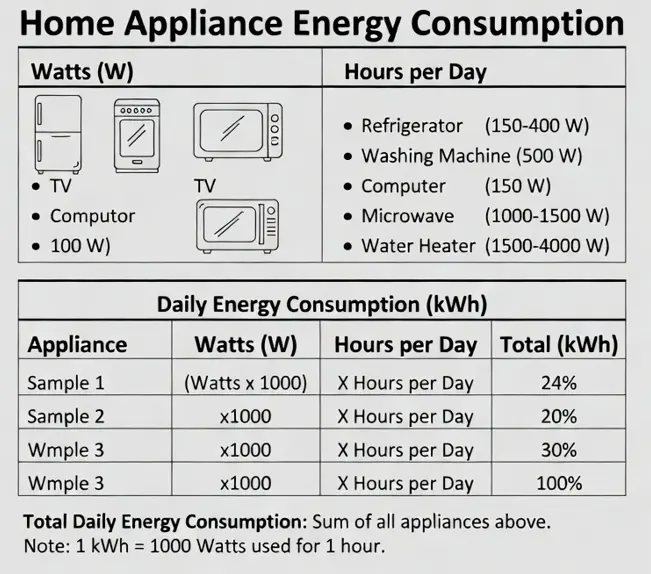
List your appliances and hours of use:
| Appliance | Power (Watts) | Hours/Day | Daily Use (Wh) |
|---|---|---|---|
| 5 LED lights | 50W | 6 hours | 300 Wh |
| Refrigerator | 200W | 10 hours | 2,000 Wh |
| Water heater | 4,500W | 0.5 hours | 2,250 Wh |
| Fans | 75W | 8 hours | 600 Wh |
| TV & outlets | 200W | 5 hours | 1,000 Wh |
| TOTAL | – | – | 6,150 Wh |
Convert to kWh: 6,150 Wh ÷ 1,000 = ~6 kWh per day
Pro tip: Always add 20{176fcca6730a93a81d392d3d2de5285aaf114f6257de59f55b47dc4f356ad4a2} for appliances you forgot and future additions.
6 kWh × 1.2 = 7.2 kWh realistic daily use
“If you want to understand the fundamentals of solar energy and how it works before diving into calculations, you can learn more about solar energy basics from the U.S. Department of Energy.”
Step 2: Know Your Solar Goal
Before calculating, ask yourself three things:
- Do you want to eliminate your electricity bill completely? (100{176fcca6730a93a81d392d3d2de5285aaf114f6257de59f55b47dc4f356ad4a2} offset)
- Or just reduce it by half? (50{176fcca6730a93a81d392d3d2de5285aaf114f6257de59f55b47dc4f356ad4a2} offset)
- Or backup power during outages? (hybrid/off-grid)
Each goal requires different system sizing.
Common Scenarios
Grid-tied (no battery): Cheapest option. Lowest cost, maximum savings. You rely on the grid at night. Best for: Most homeowners.
Hybrid (with battery): Slightly pricier. You have 1-3 days of backup power. Best for: People in areas with frequent outages.
Off-grid (full independence): Most expensive. Complete energy autonomy. Best for: Remote properties or energy independence seekers.
Step 3: Calculate Required Solar Panel Size
This is the core formula.
Required Solar Size (kW) = Daily Energy Consumption ÷ Peak Sun Hours
Peak Sun Hours = how many hours of strong sunlight your location averages daily.
- Sunny regions (Arizona, California): 5-6 hours
- Moderate regions (Colorado, Ontario): 4-5 hours
- Cloudy regions (Pacific Northwest, Atlantic Canada): 3-4 hours
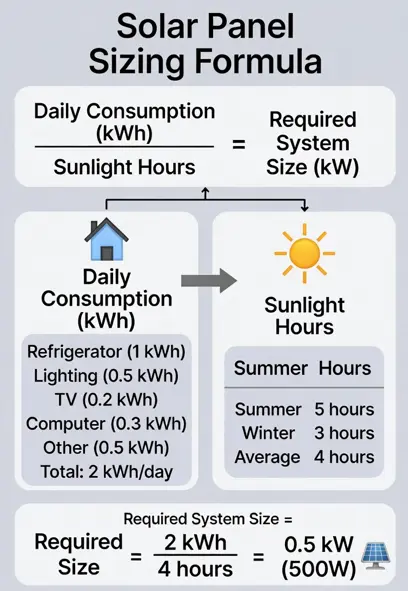
Real Example: A Home Using 15 kWh Daily
- Daily consumption: 15 kWh
- Peak sun hours in your location: 5 hours
15 kWh ÷ 5 hours = 3 kW system needed
Adjust for Real-World Losses
Solar systems lose 15-25{176fcca6730a93a81d392d3d2de5285aaf114f6257de59f55b47dc4f356ad4a2} of energy due to:
- Dust and dirt on panels
- Wiring losses
- Inverter inefficiency
- Temperature effects
Add 25{176fcca6730a93a81d392d3d2de5285aaf114f6257de59f55b47dc4f356ad4a2} buffer:
3 kW × 1.25 = 3.75 kW recommended
You’d install a 4 kW (4,000W) system.
So:
15 kWh ÷ 5 hours = 3 kW system
Simple? Yes — but wait.
Adjust for System Losses
Solar systems aren’t 100{176fcca6730a93a81d392d3d2de5285aaf114f6257de59f55b47dc4f356ad4a2} efficient. You lose energy due to:
- Dust
- Wiring losses
- Inverter inefficiency
- Temperature
So add 20{176fcca6730a93a81d392d3d2de5285aaf114f6257de59f55b47dc4f356ad4a2} buffer.
3 kW × 1.2 = 3.6 kW
You’d install roughly a 3.5–4 kW solar system.
Step 4: How Many Panels Do You Need?
Modern solar panels range from 400W to 550W.
Using 550W panels for our example:
4,000 watts ÷ 550 watts per panel = 7.3 panels
You’d install 8 panels (you can’t buy partial panels).
Each 550W panel takes ~2.5 square meters of roof space, so 8 panels need roughly 20 square meters – about the size of a small deck.
Get More Formula List and Uses HERE
Step 5: Battery Sizing (If Needed)
If you want backup power during outages or nighttime, you need batteries.
Key question: How many hours of backup do you need?
Example:
- Backup load (critical appliances only): 2 kW
- Backup duration needed: 5 hours
Energy needed = 2 kW × 5 hours = 10 kWh
For lithium batteries (LiFePO4):
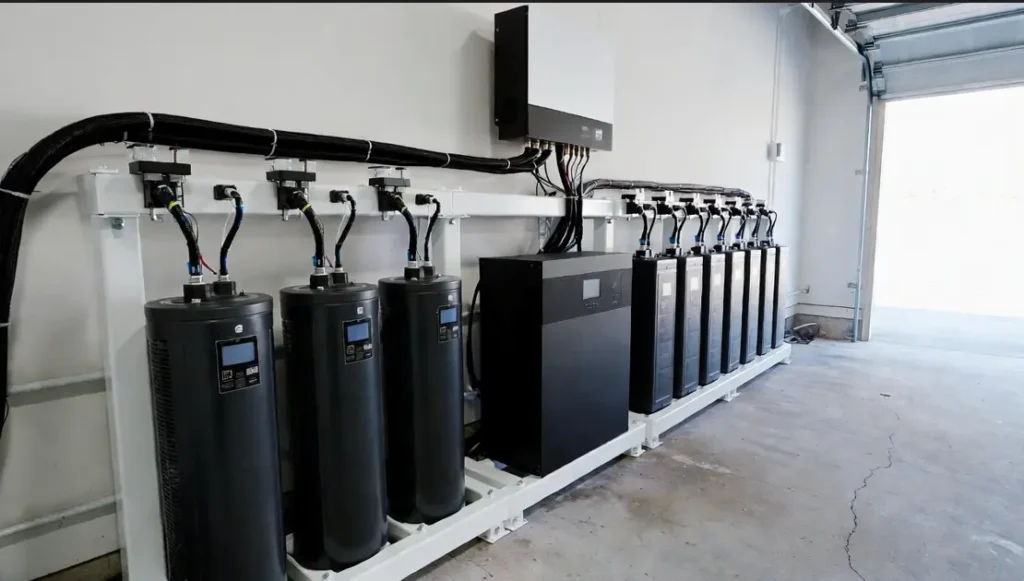
- Install 12-15 kWh capacity (always add 20{176fcca6730a93a81d392d3d2de5285aaf114f6257de59f55b47dc4f356ad4a2} buffer)
- Cost: $15,000-$25,000
For lead-acid batteries:
Cost: $6,000-$12,000 (cheaper, but shorter lifespan)
Install 20-25 kWh capacity (they discharge less deeply)
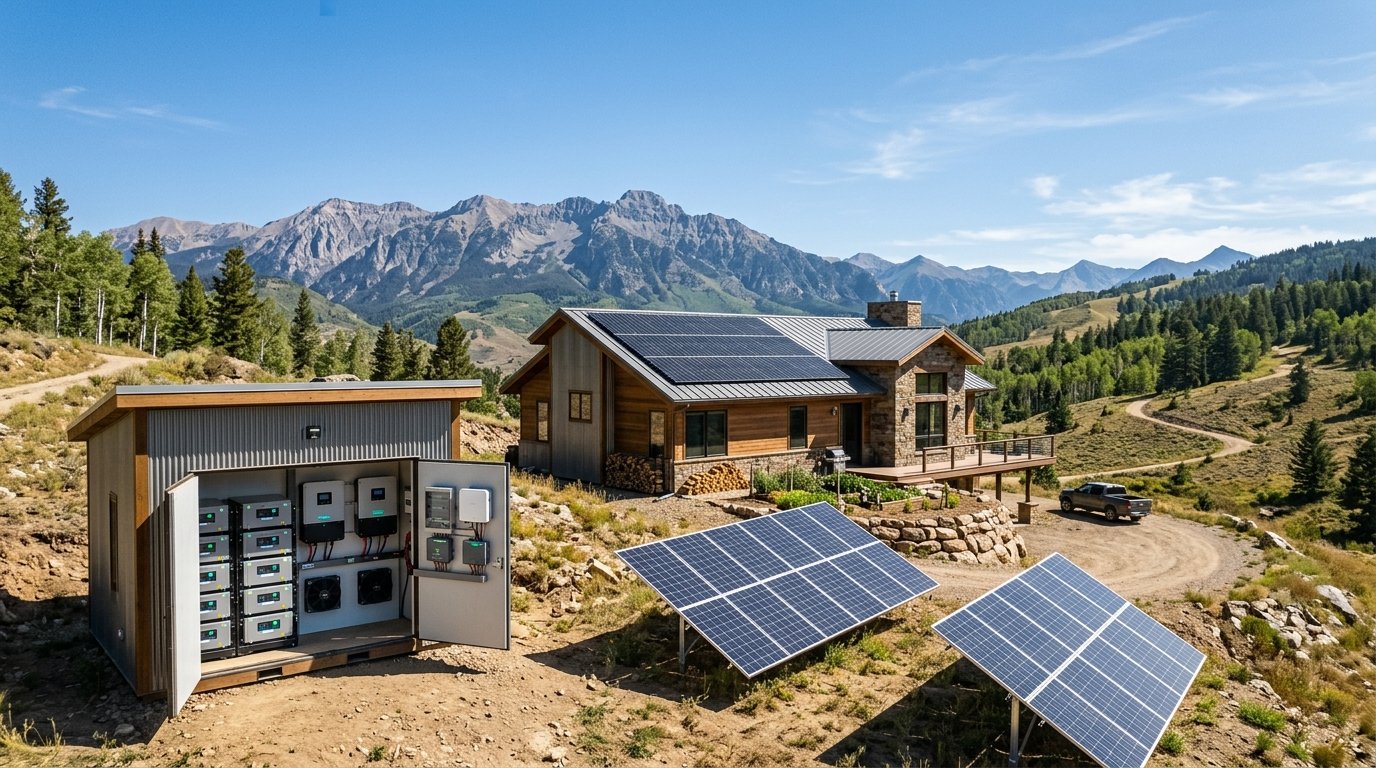
If you want to double-check your calculations and see a practical layout, you can use an off grid solar system to simulate your system before installation.
Step 6: Check Your Roof Space

Before finalizing your design, verify you actually have space.
- 8 panels at 550W each = ~20 square meters of south-facing roof
- Your roof must have minimal shade (especially 9 AM-3 PM)
- Roof must be structurally sound to support weight (about 25 kg per panel = 200 kg total)
No space? Consider ground-mounted systems instead.
Step 7: Estimate Total Cost
Rough breakdown for a 4 kW system (8 panels):
| Component | Cost |
|---|---|
| Solar panels (8 × 550W) | $2,000-$3,000 |
| Inverter (5-6 kW) | $1,500-$2,500 |
| Wiring, breakers, installation | $1,500-$2,500 |
| Total (no battery) | $5,000-$8,000 |
| With 12 kWh battery | $20,000-$33,000 |
Grid-tied systems (no battery) have the best ROI: 5-7 years.
Step 8: Real-Life Example Breakdown
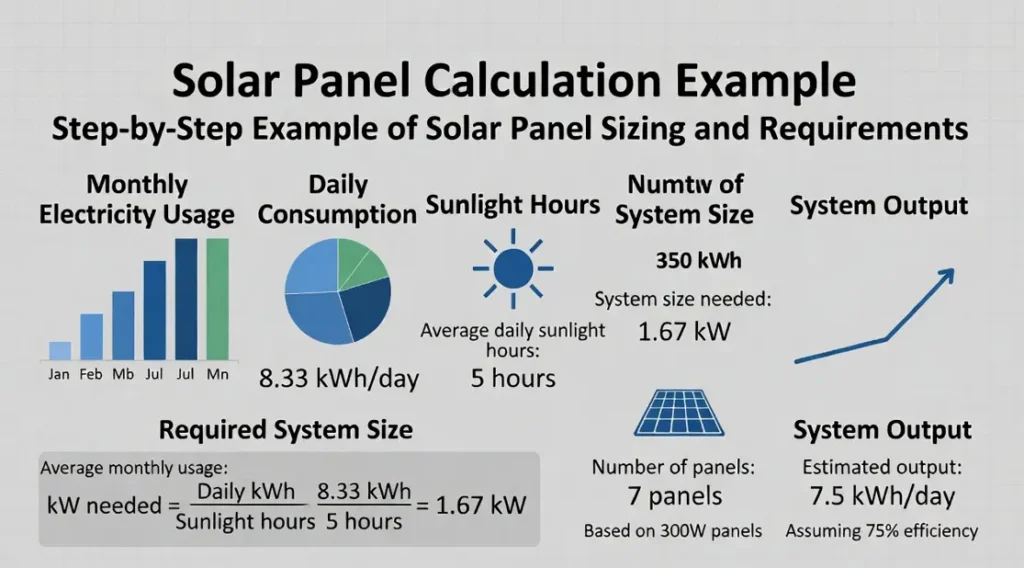
Your situation:
- Monthly electricity bill: $150
- Average consumption: 400 kWh/month = 13.3 kWh/day
- Location: Toronto (5 peak sun hours, heating needs in winter)
Calculation:
- Daily use: 13.3 kWh
- Add 20{176fcca6730a93a81d392d3d2de5285aaf114f6257de59f55b47dc4f356ad4a2} buffer: 13.3 × 1.2 = 16 kWh
- Divide by sun hours: 16 ÷ 5 = 3.2 kW
- Add 25{176fcca6730a93a81d392d3d2de5285aaf114f6257de59f55b47dc4f356ad4a2} real-world losses: 3.2 × 1.25 = 4 kW system
Result: Install 4 kW (8-9 panels at 500W each)
Expected savings: $1,500-$1,800/year (70{176fcca6730a93a81d392d3d2de5285aaf114f6257de59f55b47dc4f356ad4a2} of current bill)
Payback period: 5-6 years
25-year total savings: $30,000+
Common Mistakes to Avoid
❌ Ignoring seasonal variation – Winter has fewer peak sun hours. Don’t size for summer average.
❌ Forgetting system losses – Always add 25{176fcca6730a93a81d392d3d2de5285aaf114f6257de59f55b47dc4f356ad4a2} buffer for real-world inefficiencies.
❌ Not planning for future appliances – Adding an AC later? You’ll regret undersizing now.
❌ Neglecting roof shade – A tree or building casting winter shadow can cost 40{176fcca6730a93a81d392d3d2de5285aaf114f6257de59f55b47dc4f356ad4a2} of winter energy. Use SunCalc.org to check.
❌ Oversizing batteries unnecessarily – Don’t assume you need 30 days of autonomy. Most people only need 1-3 days.
When to Get Professional Help
While this guide covers the basics, consider hiring a solar installer for:
- Site assessment: Checking shade, roof condition, and optimal panel placement
- Electrical design: Ensuring proper wiring, breaker sizing, and safety codes
- Permitting: Handling local regulations and inspections
- Final calculations: Verifying your numbers with local data
Cost: $300-$500 for a consultation. Worth it for a $20,000+ investment.
FAQ
Q: Can one calculation work for both grid-tied and off-grid?
A: No. Off-grid needs 50-100{176fcca6730a93a81d392d3d2de5285aaf114f6257de59f55b47dc4f356ad4a2} larger batteries. Grid-tied can size panels tighter because you have backup.
Q: How much does solar cost per watt in 2026?
A: Roughly $2-3 per watt installed (all-in). So a 5 kW system costs $10,000-$15,000 before incentives.
Q: What if my roof faces east or west?
A: You’ll lose 15-20{176fcca6730a93a81d392d3d2de5285aaf114f6257de59f55b47dc4f356ad4a2} of output vs. south-facing. Still worth it, just adjust your calculations accordingly.
Q: Do solar panels work in cloudy weather?
A: Yes, at 25-50{176fcca6730a93a81d392d3d2de5285aaf114f6257de59f55b47dc4f356ad4a2} efficiency. This is why you add buffer to your calculations – cloudy days happen.
Q: How long do solar panels last?
A: Most last 25-30 years with minimal degradation (typically losing 0.5{176fcca6730a93a81d392d3d2de5285aaf114f6257de59f55b47dc4f356ad4a2} output yearly).
For More FAQs section you can VISIT HERE
Next Step: Use the Calculator
Don’t trust your manual math alone. Use our free, privacy-first OffGridCalc solar calculator to verify your numbers.
Enter:
- Your location
- Your appliance list
- Your desired autonomy (if off-grid)
Get instant results with real solar data for your city.
Takes 2 minutes. No signup. Works offline.
Final Thoughts
How to calculate solar needs for home doesn’t require a PhD. It’s just:
- Find daily consumption (from bills or appliances)
- Divide by your location’s peak sun hours
- Add buffers for real-world losses
- Determine panel count
- Add batteries if needed
- Verify roof space and cost
Done right, solar pays for itself and powers your home for 25+ years.
Done wrong, it sits unused or underpowers your life.
The difference? Following this guide.
You now know how to calculate solar needs for your home. What’s next?
© 2026 OffGridCalc. All rights reserved.