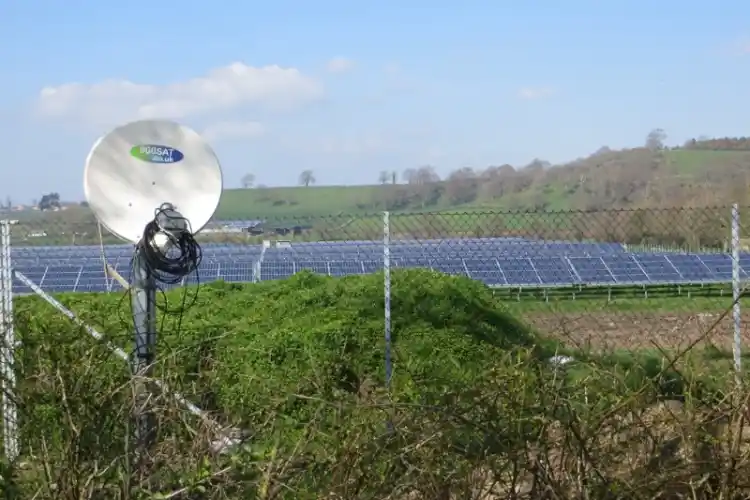
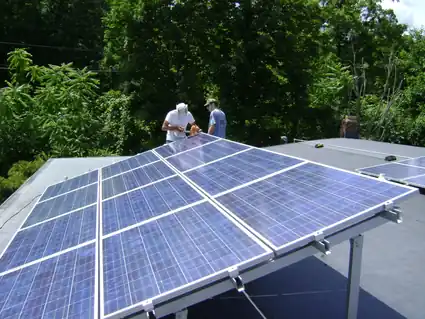
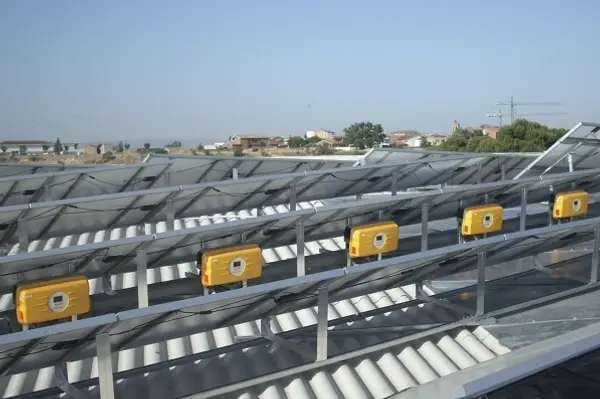
Featured photo: Field-mounted photovoltaic solar panel array delivering DC power for off-grid battery storage charging. Photo by Richard Webb on Wikimedia Commons, licensed under CC BY-SA 2.0. Resized and converted to WebP; shared under the same license.
How Many Solar Panels to Charge a 48V 100Ah Battery? (Real-World Sizing Guide)
⏱️ 17 min read (3,708 words)
🛡️ Fact-Checked: NEC 2026 & Sandia Standards
📖 Sources & References
Quick Answer: Solar Panel Count for a 48V 100Ah Battery
Fully recharging a depleted 48V 100Ah LiFePO4 battery (5,120Wh total capacity) in 5 peak sun hours requires a 1,280W solar array under real-world conditions (accounting for ~20% system losses). This translates to three to four 400W solar panels or thirteen 100W panels wired in series-parallel strings to satisfy MPPT charge controller voltage thresholds.
Common Assumption: STC Laboratory Rating
Builders assume a 1,000W array produces 1,000W continuous output, dividing 5,120Wh by 1,000W to conclude a 5-hour recharge time.
Engineering Reality: Real-World Derate
Thermal coefficient derating, MPPT tracking inefficiency, and dust soiling reduce real-world output to 75%–80% of STC nameplate. A 1,000W array delivers ~750W net power into the battery.
Critical Voltage Threshold: MPPT Startup Headroom
MPPT charge controllers require solar array operating voltage (Vmp) to sit at least 5V higher than battery absorption voltage (~56V to 58.4V for 48V LiFePO4) to initiate charging. Never wire panels strictly in parallel for 48V systems; standard 12V or 24V panels will never reach the required charging voltage. Always configure panels in series strings to achieve an array Vmp between 80V and 150V DC.
Quick Answer: Solar Panel Count for a 48V 100Ah Battery
Fully recharging a depleted 48V 100Ah LiFePO4 battery (5,120Wh total capacity) in 5 peak sun hours requires a 1,280W solar array after accounting for 20% system conversion and thermal derates. This is satisfied by four 400W solar panels (1,600W total array) wired in series or 2S2P to an MPPT charge controller rated for at least 30A charging current.
Nameplate Wattage Assumption
Builders assume a 1,000W PV array delivers 1,000 watts directly into a 48V battery bank for five continuous peak sunshine hours.
Real-World Derate Reality
High ambient panel cell temperatures, wire voltage drop, and MPPT conversion losses reduce real yields by 18% to 22%. A 1,600W array is needed to reliably replenish 5,120Wh daily.
Critical NEC 690.7 Warning: Cold-Weather Voc Voltage Multipliers
Solar panel open-circuit voltage (Voc) rises significantly as ambient temperature drops. When wiring four 400W modules in series (4S), a string with a 198V nominal Voc can exceed 235V on sub-zero winter mornings. If your MPPT charge controller is rated for 150V or 200V max input, this cold-weather voltage surge will instantly destroy the controller input FETs. Always calculate lowest recorded ambient temperatures under NEC 690.7 before finalizing string arrangements.
If you just unboxed a 48V 100Ah lithium iron phosphate (LiFePO4) battery and bought a couple of 100-watt panels hoping to top it off by lunchtime, you are in for a cold reality check. At nominal voltage, a 48V 100Ah battery stores roughly 5,120 watt-hours (5.12 kilowatt-hours) of energy. That is not a handheld power bank; it is an industrial-grade energy reservoir capable of powering an off-grid cabin for an entire day.
To fully recharge that battery in a single sunny afternoon, you cannot guess panel wattage based on headline numbers. You must account for real atmospheric conditions: sun angles, thermal loss on hot rooftops, charge controller conversion drag, and wire resistance. Here is the blunt rule: in average North American sunshine (4.5 peak sun hours), you need four 400-watt solar panels (1,600 watts total) paired with a 40-amp MPPT charge controller to reliably recharge an 80% discharged 48V 100Ah battery in one day.
Calculate Your Exact Location: Solar irradiance varies significantly between Florida, Ontario, and Alaska. Use our free Interactive Off-Grid Solar Sizing Calculator to enter your specific city coordinates and get location-calibrated peak sun hours.
1. Quick Answer: 400W Solar Panel Count vs. Sunshine Hours
How many panels you need depends entirely on where your property sits and what time of year it is. Solar engineers calculate array sizes using Peak Sun Hours (PSH)—the equivalent number of hours per day when solar irradiance hits 1,000 watts per square meter. A cloudy winter day in Seattle might deliver barely 2.5 PSH, while a clear summer day in Arizona routinely delivers over 6.0 PSH.
The table below breaks down the exact number of standard 400-watt monocrystalline panels required to recharge a 48V 100Ah LiFePO4 battery discharged to 80% Depth of Discharge (DoD), factoring in an industry-standard 80% total system efficiency derate:
Daily Solar Resource
Regional Climate Example
Min. Array Wattage
400W Panel Count
Total Array Power
Charge Time (80% DoD)
2.5 to 3.0 PSH
Winter / Overcast Northern US & Canada
1,706 W
5 Panels
2,000 W
~3.2 to 3.6 Hours
3.5 to 4.0 PSH
Spring / Autumn Continental Average
1,280 W
4 Panels
1,600 W
~3.2 to 3.5 Hours
4.5 to 5.0 PSH
Summer Average (Most of US & Southern CA)
1,024 W
3 Panels
1,200 W
~4.2 to 4.5 Hours
5.5 to 6.5 PSH
Peak Summer Southwest / Desert Sun
853 W
3 Panels
1,200 W
~3.4 to 3.8 Hours
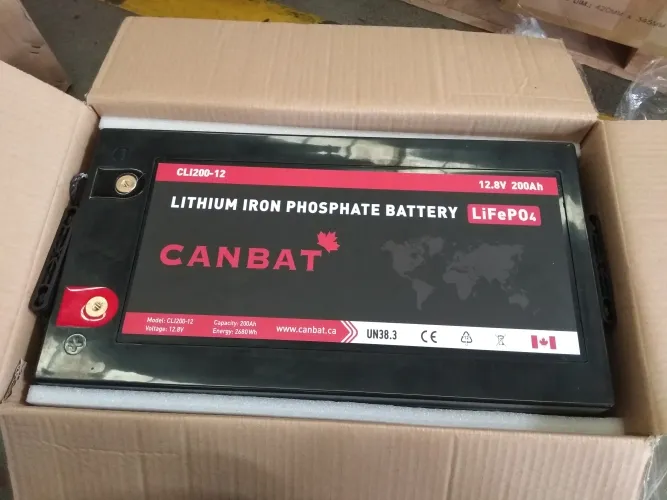
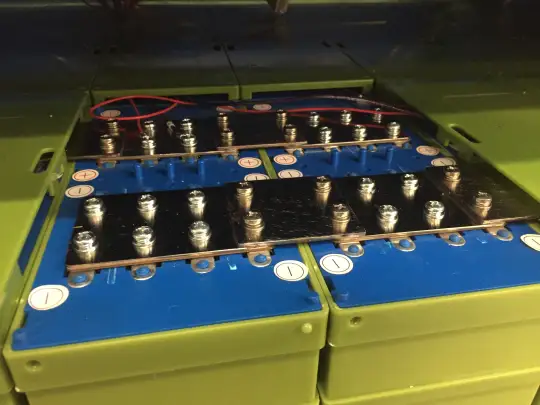
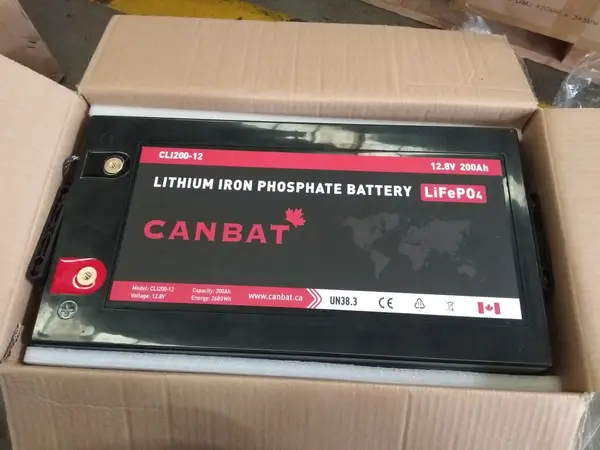
Figure 2: Heavy-duty Lithium Iron Phosphate (LiFePO4) solar storage battery pack showing sealed enclosure and high-current terminals. Photo by HasanAbuarja on Wikimedia Commons, licensed under CC BY-SA 4.0. Resized and converted to WebP; shared under the same license.
2. The Core Engineering Formula (Step-by-Step Math)
Never rely on generic sizing rules of thumb when wiring expensive lithium hardware. The arithmetic governing solar battery charging is grounded in four fundamental electrical steps:
STEP ACalculate Total Energy Capacity (Watt-Hours)
Batteries are sold in Amp-hours (Ah), but solar arrays produce energy in Watts (W). To bridge the gap, multiply nominal voltage by rated amp-hours:
Formula • Nominal Capacity
Nominal Energy (Wh) = Nominal Voltage (V) × Capacity (Ah)
51.2 V × 100 Ah = 5,120 Watt-hours (5.12 kWh)
Engineering Note: Standard lithium iron phosphate (LiFePO4) battery modules use 16 prismatic cells in series (16 × 3.2V = 51.2V nominal), rather than an even 48.0V. Using 51.2V yields the true nominal baseline of 5,120 Wh.
STEP BFactor in Usable Depth of Discharge (DoD)
Unlike old lead-acid batteries that degrade catastrophically if taken below 50% capacity, quality LiFePO4 batteries routinely cycle to 80% or 90% Depth of Discharge without premature capacity fade. For maximum cell lifespan (typically 4,000 to 6,000 cycles), sizing for an 80% daily cycling window is standard practice:
Formula • Usable Energy Target
Daily Usable Energy Needed = Nominal Energy × Depth of Discharge (DoD)
5,120 Wh × 0.80 = 4,096 Watt-hours (~4.1 kWh)
STEP CApply the 20% Real-World System Loss Derate
A solar panel rated at 400 watts in a laboratory Standard Test Condition (STC: 25°C cell temp, 1,000 W/m² light) almost never produces 400 continuous watts outdoors. The National Renewable Energy Laboratory (NREL) PVWatts model documents that real-world arrays lose roughly 18% to 22% of headline nameplate capacity to:
Thermal Coefficient Losses (10% to 14%): As dark panels bake under direct summer sun, cell temperatures climb to 50°C–65°C, reducing voltage and power output.
MPPT Controller Conversion Efficiency (2% to 4%): Modern high-efficiency tracking algorithms operate between 96% and 98% efficiency.
DC Cable Voltage Drop & Soiling (3% to 5%): Resistive losses across copper conductors, branch connectors, and airborne dust.
To safely account for these field realities, apply an overall 0.80 performance ratio (80% system efficiency):
Formula • Gross Daily PV Production Target
Required Daily Solar Production = Usable Energy ÷ Balance-of-System Efficiency (0.80)
Finally, divide your gross required watt-hours by your location’s design-month Peak Sun Hours. In a region receiving 4.0 PSH:
Formula • Array Sizing & Panel Count
Array Wattage = 5,120 Wh ÷ 4.0 PSH = 1,280 Watts
Number of 400W Panels = 1,280 W ÷ 400 W = 3.2 panels (Round up to 4 panels = 1,600 W)
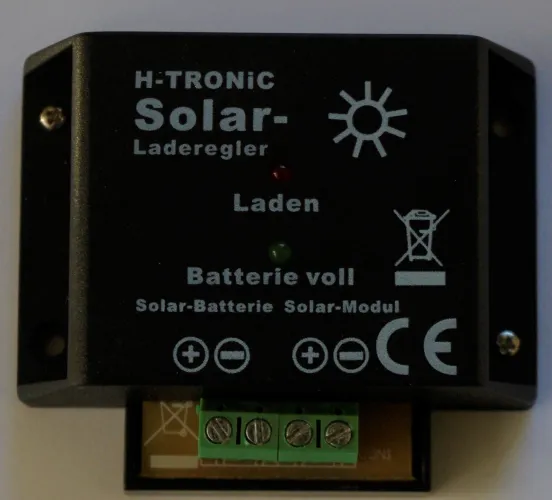
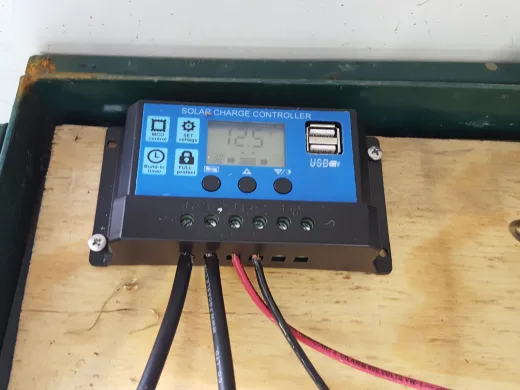
Figure 3: Dedicated solar charge controller regulating DC voltage between the solar array and the battery storage bank. Photo by MAmberg on Wikimedia Commons, licensed under CC BY-SA 4.0. Resized and converted to WebP; shared under the same license.
3. Sizing Your MPPT Charge Controller for 48V
Your solar panels do not connect directly to the battery posts. A Maximum Power Point Tracking (MPPT) charge controller acts as a DC-to-DC transformer, taking high-voltage DC power from your roof and stepping it down to the exact 54.0V–56.8V absorption threshold required by LiFePO4 cells while stepping up the charging amperage.
To determine the correct charge controller size, divide your total array wattage by the battery’s bulk charging voltage (roughly 51.2V to 54.0V):
Solar Array Size
Charging Voltage
Max Output Current
Recommended MPPT Size
Battery C-Rate Impact
1,200 W (3x 400W)
54.0 V
22.2 A
30A MPPT (150V / 30A)
0.22C (Gentle / Ideal)
1,600 W (4x 400W)
54.0 V
29.6 A
40A MPPT (150V / 40A)
0.30C (Optimal balance)
2,000 W (5x 400W)
54.0 V
37.0 A
50A or 60A MPPT
0.37C (Fast recharge)
The Battery Longevity Rule (C-Rate Limits): Most 100Ah LiFePO4 battery management systems (BMS) allow a maximum continuous charge rate of 0.5C to 1.0C (50A to 100A). However, according to research published by the U.S. Department of Energy (DOE), charging lithium iron phosphate cells at conservative rates between 0.2C (20A) and 0.4C (40A) generates minimal internal heat, minimizes cell degradation, and maximizes cycle longevity over 10 to 15 years of daily use. Sizing a 1,600W array with a 40A controller hits this sweet spot perfectly.
For detailed controller voltage window calculations and oversizing rules, see our dedicated guide on Solar Charge Controller Sizing.
Figure 4: Weatherproof MC4 male and female solar connectors used for series and parallel array wiring. Photo by Multi-Contact AG on Wikimedia Commons, licensed under CC BY-SA 3.0. Resized and converted to WebP; shared under the same license.
4. Array Wiring: Series vs. Parallel Strings (NEC 690.7 Safety)
Once you select four 400-watt panels, how should you wire them? You have three distinct options, each with serious electrical consequences:
Option 1: All 4 Panels in Series (4S String) — Recommended for Most MPPTs
Connecting all 4 panels positive-to-negative in series adds their voltages together while current remains constant. If each 400W panel has an open-circuit voltage (Voc) of 41.5V and an operating current (Imp) of 10.2A:
Total Array Operating Voltage: 34.5V × 4 = 138.0 Volts DC
Total Array Current: 10.2 Amps DC
The Major Advantage: Operating at 10.2A allows you to use standard 10 AWG copper solar wire over long roof runs without significant voltage drop.
⚠️ Crucial NEC 690.7 Cold Temperature Warning: Photovoltaic cells generate higher voltage as temperatures drop. Under National Electrical Code (NEC) Article 690.7, you must calculate maximum array Voc at the record-low winter temperature of your site using the manufacturer’s negative temperature coefficient (typically -0.28%/°C). If four panels produce 166V Voc at 25°C, that same string can spike past 195V DC on a sub-zero morning. If your MPPT controller has a 150V maximum input limit, a 4S string will permanently fry its internal transistors. In cold northern climates with a 150V controller, use a 2S2P configuration instead.
Option 2: Two Strings in Parallel (2S2P Configuration)
Wire panels in two pairs of series strings, then combine the two pairs in parallel using MC4 branch combiners. This cuts array voltage in half while doubling current:
Total Array Operating Voltage: 34.5V × 2 = 69.0 Volts DC
Total Array Current: 10.2A × 2 = 20.4 Amps DC
At 69V nominal, cold morning spikes stay safely below 100V, making this configuration 100% safe for standard 150V MPPT charge controllers in freezing climates like New York, Minnesota, or Canada.
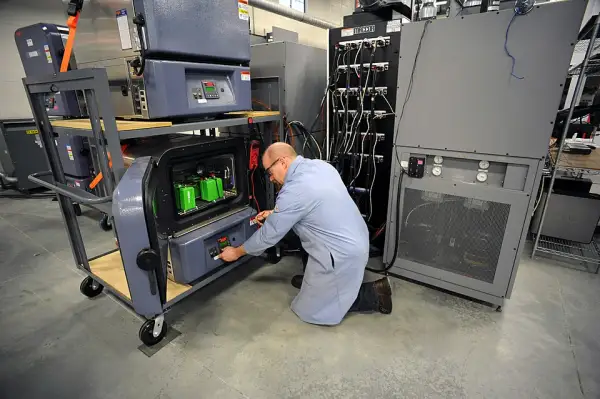
Figure 5: Advanced power electronics and solar inverter research system at Oak Ridge National Laboratory. Photo by Oak Ridge National Laboratory (U.S. Department of Energy) on Wikimedia Commons, licensed under CC BY 2.0. Resized and converted to WebP; shared under the same license.
If your 48V battery powers LED lighting, a 12V water pump, and a small refrigerator during Friday and Saturday night, and the cabin sits empty Monday through Thursday, you do not need a massive 1,600W array. A modest two-panel array (800W total) producing 2,500 Wh/day will comfortably restore the battery to 100% state-of-charge over several weekdays before your next arrival.
In a full-time residential setup where the battery discharges 4 kWh every single night running household refrigeration, internet routers, lights, and entertainment, you have only one daylight window (9:00 AM to 3:30 PM) to recharge the battery while simultaneously serving daytime running loads. In this scenario, install at least five 400W panels (2,000 watts total). This provides 400W of dedicated overhead to power daytime appliances while channeling 1,600W directly into bulk battery absorption.
6. Verify Your Location Before Purchasing Modules
Never order panels based on national averages. A cabin in northern Ontario requires nearly twice the array wattage in December compared to June to produce the same 4,000 watt-hours. To eliminate guesswork, model your proposed setup through the free OffGridSolarCalc Sizing Tool. It checks your geographical sun data, calculates required wire gauges, and ensures your array stays within legal electrical code limits.
To understand why 48V systems are universally superior to 12V and 24V banks for stationary battery storage, explore our comprehensive technical benchmark on 12V vs 24V vs 48V Solar: Which Battery Voltage Fits?.
Array Architecture & Charge Parameters:
Array Nameplate Required: 1,365 Watts DC
Number of Panels Needed: 4 Panels (1,600W Total)
Min. MPPT Controller Sizing: 30A – 35A @ 48V
Actual Recharge Time: 3.4 Peak Sun Hours
Calculating 48V 100Ah charging requirements…
Frequently Asked Questions
1. How many solar panels does it take to charge a 48V 100Ah battery?
A standard 48V 100Ah LiFePO4 battery stores 5,120 Watt-hours (Wh) of nominal energy. Accounting for real-world system inefficiencies (roughly 20% losses from MPPT conversion, wire resistance, and battery chemical absorption), you need approximately 6,400 Wh of raw PV generation. In an area receiving 4.0 Peak Sun Hours (PSH) per day, you require a 1,600W array, which equals exactly four 400W solar panels or sixteen 100W panels.
2. How long does it take to charge a 48V 100Ah battery with solar?
Recharge time depends directly on your solar array wattage and instantaneous solar irradiance. With a properly sized 1,600W solar array operating through a 30A MPPT controller, a fully depleted 48V 100Ah battery recharges from 0% to 100% in approximately 3.5 to 4.5 peak sun hours. If using a smaller 800W array (two 400W panels), complete recharging takes roughly 7 to 8 peak sun hours, which typically requires two full sunny days.
3. What size MPPT charge controller is needed for a 48V 100Ah battery?
Charge controller sizing is governed by maximum continuous output current into the 48V battery bank. For a 1,600W solar array, dividing total array wattage by nominal battery absorption voltage (56V to 58V) yields approximately 28 to 30 Amps (1,600W / 54V = 29.6A). Therefore, a 30A or 40A MPPT charge controller rated for at least 150V DC maximum input voltage is the recommended engineering baseline.
4. Should I wire my solar panels in series or parallel for a 48V battery?
Wiring panels in series (or a series-parallel 2S2P arrangement) is mandatory when charging a 48V battery. MPPT charge controllers require incoming array voltage (Vmp) to be at least 5V higher than the instantaneous battery voltage to initiate charging. A single typical 400W panel has a Vmp of around 37V to 42V, which is lower than a 48V battery (51.2V nominal, 58.4V full). Wiring four panels in series yields ~160V Vmp, providing optimal MPPT tracking efficiency and reducing cable current down to roughly 10 Amps.
48V Battery Charging Commissioning SOP Checklist
Verify MPPT charge controller maximum open-circuit voltage (Voc) rating exceeds cold-weather temperature-adjusted array Voc by at least 15%.
Program custom lithium charge profile: 56.8V bulk/absorption, 54.0V float, and disable temperature compensation for LiFePO4 chemistry.
Confirm that total charging current does not exceed the recommended maximum 0.5C rate (50A for a 100Ah battery) to preserve cell longevity.
Install a polarized DC circuit breaker between PV array and MPPT controller to allow safe maintenance isolation under load.
Torque all 48V battery busbar and terminal connections to manufacturer specification (typically 8 to 10 Nm) using calibrated torque wrench.
Sponsored Recommendations
Interactive Sizing Tool
48V 100Ah Battery Charge Time & Solar Array Sizing Simulator
Calculate required solar panel wattage, recharge duration, MPPT charge controller sizing, and string series-parallel architecture for a 5,120 Wh 48V LiFePO4 battery bank.
Amount of depleted energy requiring replenishment.
Available daily peak sun hours to complete bulk and absorption charge.
Module form factor determines string voltage and roof footprint.
Accounts for thermal panel losses, MPPT conversion, and wiring resistance.
Array Architecture & Charge Parameters:
Array Nameplate Required: 1,365 Watts DC
Number of Panels Needed: 4 Panels (1,600W Total)
Min. MPPT Controller Sizing: 30A – 35A @ 48V
Actual Recharge Time: 3.4 Peak Sun Hours
Calculating 48V 100Ah charging requirements...
Verified Hardware Benchmarks Direct Amazon Link
Recommended 48V Battery & Solar Hardware
Field-tested lithium energy storage and portable solar arrays for 48V systems:
Super Empower 12.8V 100Ah LiFePO4 Deep Cycle Battery
Delivers 1,280Wh usable storage, 100A continuous BMS discharge, sub-freezing thermal protection, and supports modular 2S/4S configurations up to 48V.
High-efficiency monocrystalline folding solar array with built-in adjustable kickstands, durable ETFE coating, and standard MC4 connectors for auxiliary charging.
1. How many solar panels does it take to charge a 48V 100Ah battery?
A standard 48V 100Ah LiFePO4 battery stores 5,120 Watt-hours (Wh) of nominal energy. Accounting for real-world system inefficiencies (roughly 20% losses from MPPT conversion, wire resistance, and battery chemical absorption), you need approximately 6,400 Wh of raw PV generation. In an area receiving 4.0 Peak Sun Hours (PSH) per day, you require a 1,600W array, which equals exactly four 400W solar panels or sixteen 100W panels.
2. How long does it take to charge a 48V 100Ah battery with solar?
Recharge time depends directly on your solar array wattage and instantaneous solar irradiance. With a properly sized 1,600W solar array operating through a 30A MPPT controller, a fully depleted 48V 100Ah battery recharges from 0% to 100% in approximately 3.5 to 4.5 peak sun hours. If using a smaller 800W array (two 400W panels), complete recharging takes roughly 7 to 8 peak sun hours, which typically requires two full sunny days.
3. What size MPPT charge controller is needed for a 48V 100Ah battery?
Charge controller sizing is governed by maximum continuous output current into the 48V battery bank. For a 1,600W solar array, dividing total array wattage by nominal battery absorption voltage (56V to 58V) yields approximately 28 to 30 Amps (1,600W / 54V = 29.6A). Therefore, a 30A or 40A MPPT charge controller rated for at least 150V DC maximum input voltage is the recommended engineering baseline.
4. Should I wire my solar panels in series or parallel for a 48V battery?
Wiring panels in series (or a series-parallel 2S2P arrangement) is mandatory when charging a 48V battery. MPPT charge controllers require incoming array voltage (Vmp) to be at least 5V higher than the instantaneous battery voltage to initiate charging. A single typical 400W panel has a Vmp of around 37V to 42V, which is lower than a 48V battery (51.2V nominal, 58.4V full). Wiring four panels in series yields ~160V Vmp, providing optimal MPPT tracking efficiency and reducing cable current down to roughly 10 Amps.
48V Battery Charging Commissioning SOP Checklist
Verify MPPT charge controller maximum open-circuit voltage (Voc) rating exceeds cold-weather temperature-adjusted array Voc by at least 15%.
Program custom lithium charge profile: 56.8V bulk/absorption, 54.0V float, and disable temperature compensation for LiFePO4 chemistry.
Confirm that total charging current does not exceed the recommended maximum 0.5C rate (50A for a 100Ah battery) to preserve cell longevity.
Install a polarized DC circuit breaker between PV array and MPPT controller to allow safe maintenance isolation under load.
Torque all 48V battery busbar and terminal connections to manufacturer specification (typically 8 to 10 Nm) using calibrated torque wrench.
Advertisement
📚
Technical References & Authoritative Sources
Our technical guides are cross-referenced against authoritative electrical standards, government energy research institutions, and certified hardware specifications. Explore the core reference publications behind our calculations below. For full documentation, visit our Sources & References Directory, NEC Solar Code Directory, and Calculation Methodology.
🛰️ European Commission PVGIS DatabasePhotovoltaic Geographical Information System. Satellite solar irradiance and peak sun hours (PSH) models for precise geographical sizing.
🔬 NREL (National Renewable Energy Laboratory)PVWatts Calculator & U.S. Dept. of Energy models for solar derate factors, temperature coefficients, and system loss estimation.
🏛️ Sandia National LaboratoriesStand-Alone Photovoltaic System Simulation & Loss-of-Load Probability (LOLP) algorithms (SAND87-2379 / OSTI ID: 6207302).
📑 IRS Residential Clean Energy Credit (Form 5695)Section 25D provides a 30% federal clean energy tax credit for qualifying off-grid solar and battery storage systems (3+ kWh capacity) placed in service through 2032.
Educational Content Creator & Renewable Energy Researcher
PK Basnet is an educational content creator and independent researcher behind OffGridSolarCalc. Passionate about clean energy education, he synthesizes publicly available electrical guidelines (NEC/NFPA 70), climatological datasets (NREL PVWatts), and manufacturer specifications into transparent planning calculators and practical educational guides for homeowners, cabin planners, and students.
📖Educational Standards & Research Methodology:
Every guide and calculation tool on this site is developed under a disciplined educational framework: mathematical Loss-of-Load Probability (LOLP) modeling formulated by Sandia National Laboratories (Report SAND87-2379), NREL string derating factors, code-grounded principles (NEC Articles 690, 705 & 706), empirical insolation data (EU PVGIS-ERA5), manufacturer engineering datasheet cross-referencing, and public errata tracking. Our tools illustrate preliminary sizing math for educational planning and do not replace professional installation review by a licensed electrical contractor.