Solar panel installation cost is usually about $3 to $4 per watt before incentives, putting a typical 8-kilowatt home system in the rough range of $24,000 to $32,000. A straightforward roof and a standard grid-tied design sit closer to the lower end; difficult roof access, electrical upgrades, premium equipment, or battery storage can push the total higher. Those are planning figures, not a guaranteed quote.
The federal residential 30{176fcca6730a93a81d392d3d2de5285aaf114f6257de59f55b47dc4f356ad4a2} credit is no longer an automatic reduction for new qualifying expenditures after December 31, 2025. So, in 2026, homeowners should compare the full installed price first, then subtract only incentives they have verified for their location and project.
National Solar Panel Installation Cost Range in 2026
A useful way to compare solar quotes is price per watt. Multiply the system’s direct-current capacity by the quoted price per watt, then check whether the result includes installation, permitting, interconnection, sales tax, and every piece of equipment.
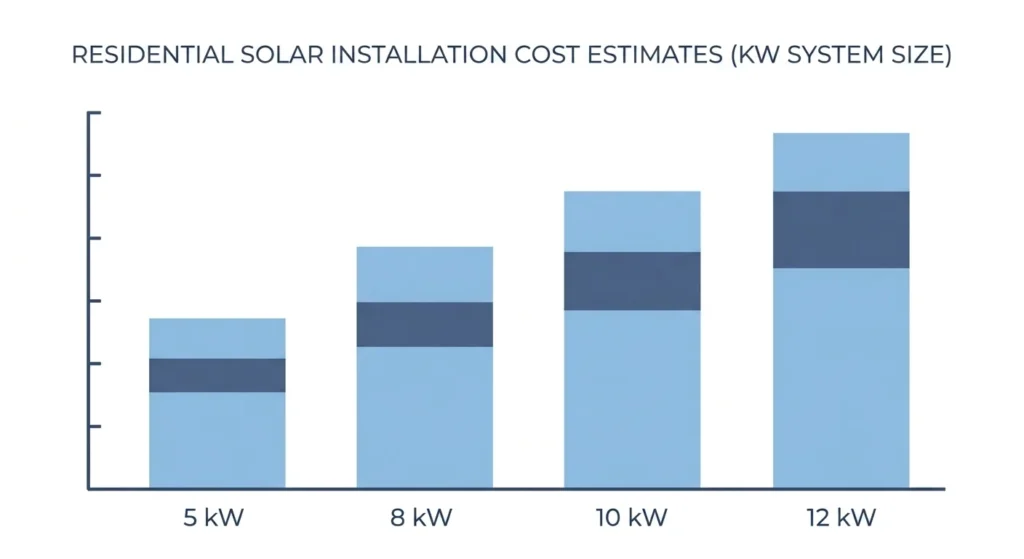
For a professionally installed residential system in the United States, a practical 2026 planning range is roughly $3 to $4 per watt before local incentives. That means the base installation might look like this:
| System size | Approximate installed price at $3–$4/W |
|---|---|
| 5 kW | $15,000–$20,000 |
| 8 kW | $24,000–$32,000 |
| 10 kW | $30,000–$40,000 |
| 12 kW | $36,000–$48,000 |
These totals describe solar-only systems. Batteries, roof repairs, major panel upgrades, trenching, unusual structural work, and other extras can sit outside the headline price.
The latest national benchmark I found from the Solar Energy Industries Association, published in its 2025 year-in-review market report, put residential system pricing at about $3.39 per watt in the fourth quarter of 2025. That’s a useful reference point for 2026 planning, but it isn’t a promise that every homeowner will receive a quote near that number. Market conditions, equipment supply, financing, local wages, and site complexity all affect the final invoice.
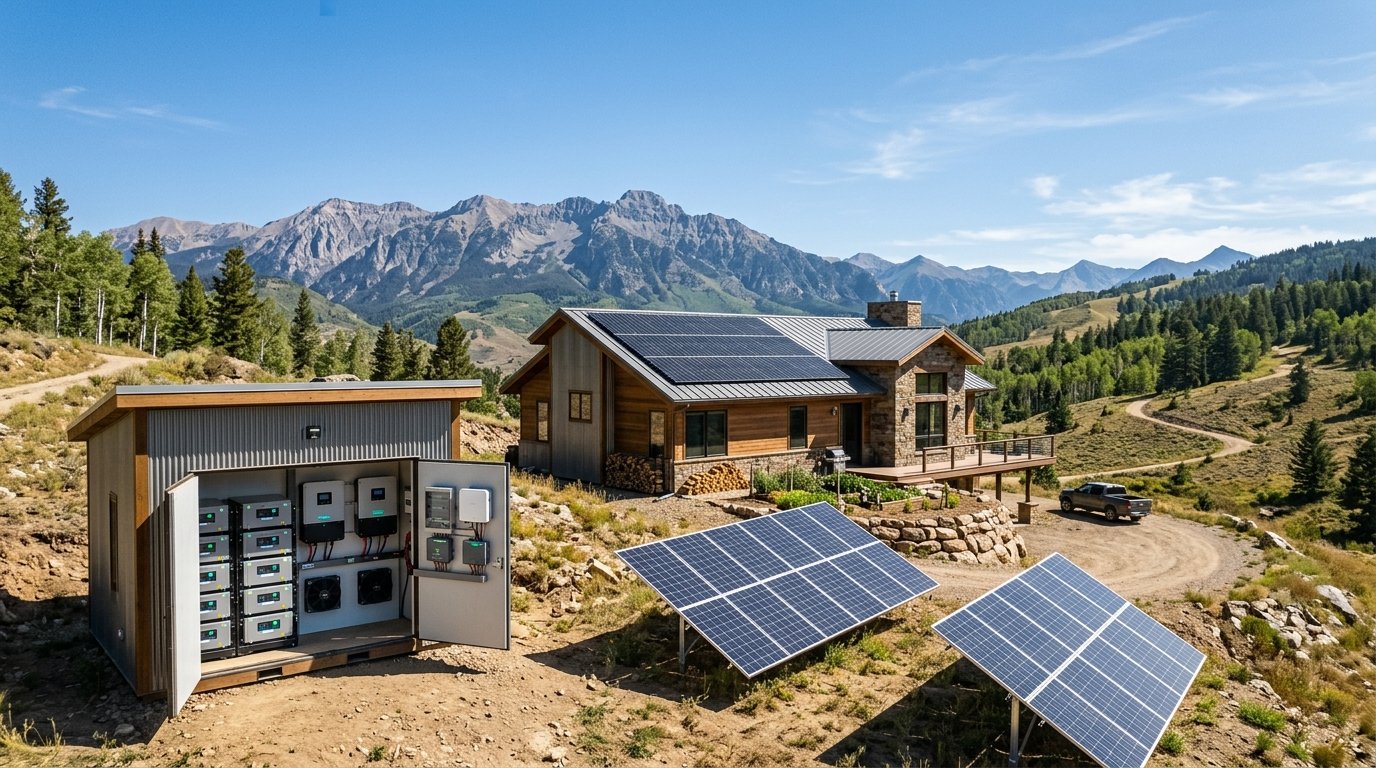
For another way to think about the total, see the Off-Grid Solar System Cost 2026 guide. Off-grid projects usually add batteries, larger inverters, backup capacity, and more complicated design work, so they shouldn’t be compared directly with a basic grid-tied installation.
What Determines Solar Panel Installation Cost?
Two homes on the same street can receive very different quotes. The panel count is only one part of the job.
System size
Larger systems cost more in total, but they often cost less per watt because fixed expenses are spread across more panels. Design work, permitting, mobilization, and some labor occur whether the installer mounts six panels or twenty-four.
That doesn’t mean you should buy the largest system offered. Oversizing can leave you paying for production you don’t use, especially if your utility limits export credits or changes its rate structure. Start with annual electricity use, future loads, roof space, and the utility’s interconnection rules.
The Off-Grid Solar System Sizing guide can help explain the sizing logic. Even for a grid-connected home, the same basic question applies: how much energy do you actually need the system to produce?
Roof type, pitch, and access
A simple, low-slope asphalt-shingle roof is usually easier to work on than a steep roof with multiple planes. Tile, slate, metal, and older roofing materials can require different mounting methods and more careful handling.

Installers also price the work based on access. A two-story home with limited space for ladders, a detached garage, or a long walk from the driveway to the roof can add labor. Trees and nearby structures create design and safety complications even when they don’t add a line item called “shade cost.”
Panel brand and efficiency
Premium panels generally cost more per unit. High efficiency can be valuable when roof space is limited, but it doesn’t automatically make a system cheaper overall. A lower-cost panel that fits the roof may outperform a premium panel that forces an expensive layout or adds little usable production.
Compare the complete system, not just the panel name. Check the product warranty, degradation guarantee, temperature behavior, inverter compatibility, and installer support.
Labor rates by region
Solar installation is local work. Wages, insurance, travel time, competition, licensing requirements, and demand can vary sharply between regions. A quote in a large metro area may include higher labor and permitting costs than a similar system in a smaller market. Remote locations can also cost more because crews and equipment must travel farther.
This is why a national average is a starting point, not a local price sheet. Your own address matters more than a headline number.
Permits and inspections
Most grid-connected systems require permits, utility paperwork, inspections, and final approval before the system can operate normally. Some installers include these steps in their base price. Others show them as separate charges.
Ask exactly what is included. “Permitting included” should generally mean the installer prepares and submits the required documents, pays ordinary permit fees if promised, schedules inspections, and handles corrections. Confirm whether utility interconnection fees are included too.
Electrical panel upgrades
A solar installation may require a main service panel upgrade, load-management equipment, a new breaker arrangement, or other electrical work. Older panels, crowded breaker boxes, and homes with high electrical demand are common triggers.
A panel upgrade can be a modest add-on or a much larger project if the service entrance, meter location, wiring, or utility connection also needs work. Don’t wait until the contract is signed to ask. The installer should identify likely electrical requirements during the site assessment.
Equipment Cost vs. Labor Cost
A professionally installed solar panel installation cost commonly divides into two broad buckets: equipment and soft costs on one side, installation labor and project delivery on the other. The split varies by project, but a reasonable planning model is roughly 60{176fcca6730a93a81d392d3d2de5285aaf114f6257de59f55b47dc4f356ad4a2} to 70{176fcca6730a93a81d392d3d2de5285aaf114f6257de59f55b47dc4f356ad4a2} equipment and project materials, and 30{176fcca6730a93a81d392d3d2de5285aaf114f6257de59f55b47dc4f356ad4a2} to 40{176fcca6730a93a81d392d3d2de5285aaf114f6257de59f55b47dc4f356ad4a2} labor, design, permitting, overhead, and installation services.
That isn’t an accounting rule. A premium equipment package can raise the equipment share. A difficult roof or an expensive local permitting process can raise the service share.
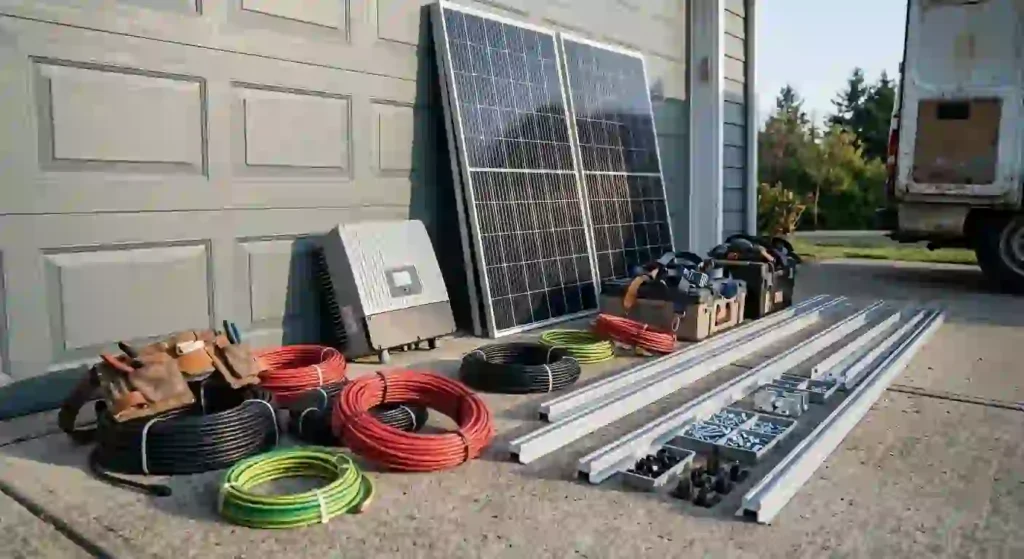
Equipment usually includes
- Solar modules
- Inverters or microinverters
- Racking and roof attachments
- Disconnects, breakers, wiring, and other balance-of-system components
- Monitoring hardware
- Labels and required safety equipment
A battery-inclusive installation adds the battery, control equipment, additional wiring, and often a critical-loads panel or backup gateway.
Labor and project delivery usually includes
- Site assessment and system design
- Engineering review
- Roof layout and structural checks
- Permit preparation and submission
- Installation crew time
- Electrical work
- Inspection support
- Utility interconnection paperwork
- Commissioning and customer handoff
Look for a quote that makes this division clear. A single total isn’t automatically suspicious, but an itemized scope makes it easier to compare three installers on equal terms.
Why Regional Costs Vary So Much
Solar installation prices differ by region because the job itself differs. Local labor is one factor. Utility rules are another. A utility with a complicated interconnection process can create more engineering and administrative work than one with a simple online application.
Weather matters too. Snow loads, hurricanes, high heat, wildfire requirements, and wind exposure can affect the racking, structural review, and installation schedule. Roof design varies by building tradition, while local permitting departments have different fees and documentation requirements.
Electricity prices also influence what installers can charge and how homeowners evaluate the investment. In an area with expensive utility electricity, a higher solar quote may still produce an attractive payback. In a lower-rate market, the same system may require a closer look at financing and future utility increases.
Avoid state-by-state price lists that pretend to be precise. They often mix different system sizes, financing structures, incentives, and roof conditions. Ask local installers for cash prices and compare the scope line by line.
A general way to think about regional cost tiers
Without pretending to give you a state-by-state price sheet, most residential markets in the U.S. fall into three rough cost tiers based on labor rates, permitting complexity, and demand:
| Market type | Typical price-per-watt tendency | Common drivers |
|---|---|---|
| Dense urban / high cost-of-living metro | Tends toward the higher end of the $3–$4/W range, sometimes above it | Higher labor wages, stricter permitting, more inspection steps, higher demand |
| Mid-size city / suburban | Tends to sit near the middle of the $3–$4/W range | Balanced competition, moderate permitting timelines |
| Rural / lower cost-of-living area | Can trend toward the lower end of the range | Lower labor costs, simpler permitting, though travel time for crews can offset some savings |
These are tendencies, not guarantees. A rural home with a difficult roof can still cost more than an easy urban install. Use this only as a starting expectation, then let actual local quotes correct it.
The Federal 25D Credit Has Expired for New 2026 Expenditures
Older solar articles often show a $30,000 system becoming a $21,000 system after a 30{176fcca6730a93a81d392d3d2de5285aaf114f6257de59f55b47dc4f356ad4a2} federal tax credit. That calculation is not a safe 2026 default.
The IRS states that the Residential Clean Energy Credit under Section 25D ended for qualifying expenditures after December 31, 2025. For a new residential solar project in 2026, the installation cost should therefore be treated as the full pre-incentive price unless another verified program applies.
This does not erase every earlier-year tax question. A homeowner with an eligible 2025 project, an unused credit carryforward, or a complicated installation timeline should review the applicable tax-year rules and records with a qualified tax professional. It also doesn’t mean state rebates or utility incentives disappeared.
For the details, read the Federal Solar Tax Credit 2026 guide before using any tax benefit in your project spreadsheet. Don’t let an installer’s old sales calculator quietly reduce your quote by 30{176fcca6730a93a81d392d3d2de5285aaf114f6257de59f55b47dc4f356ad4a2}.
Hidden and Overlooked Costs
The headline price can look complete while leaving out work your home needs.
Roof repairs or replacement
Solar panels can last for decades. If the roof has only a few years left, installing panels now may mean paying to remove and reinstall them later. Ask for a roof assessment before the contract is final. A roof replacement is normally a separate construction project, not a minor solar add-on.
Monitoring and communications
Some systems include monitoring at no extra cost. Others require a gateway, cellular connection, internet access, or a paid monitoring service. Ask what you can see after installation and whether the app or cellular service has an ongoing fee.
Trenching and detached buildings
A detached garage, workshop, or ground-mounted array may need trenching, conduit, a longer wire run, or a separate foundation. Those costs can be significant even when the panel count stays the same.
Utility and inspection fees
Permit fees, plan-review fees, utility application fees, inspection charges, and meter work may be separate. Get a written list of exclusions.
Financing charges
A financed solar project can cost much more than the cash price after dealer fees, origination charges, interest, and optional add-ons. Compare the total amount repaid, not only the monthly payment. For broader ROI and financing planning, see the Complete Off-Grid Solar Financial Planning Guide.
DIY vs. Professional Installation
DIY installation can reduce solar panel installation cost, but it doesn’t make the whole project free. You still need equipment, design, racking, wiring, permits, inspections, and safe electrical work.
For a capable homeowner installing a small ground-mounted or off-grid system, DIY labor savings might be meaningful. Grid-connected rooftop work is a different risk category. Roof falls, incorrect wiring, water intrusion, overloaded circuits, and failed inspections can erase the savings quickly.
Professional installation usually costs more upfront, but it brings trained labor, engineering support, permit experience, workmanship coverage, and a clear path for utility approval. It may also preserve equipment warranty conditions that depend on approved installation practices.
A practical compromise is to do the planning and research yourself, then obtain a professional installation quote. You’ll understand the proposal better without taking on the most dangerous parts of the job.
How to Get an Accurate Solar Quote
Start with three written quotes, not three casual conversations. Give each installer the same recent electricity bills and ask for the same system assumptions.

Request these details:
- System size in kWdc and estimated annual production
- Panel and inverter model numbers
- Racking and attachment method
- Cash price before incentives
- Every permit, inspection, interconnection, and utility fee
- Roof repairs or electrical work included and excluded
- Battery price, usable capacity, and backup circuits if applicable
- Monitoring equipment and recurring fees
- Production guarantee and workmanship warranty
- Payment schedule and financing total
- Expected installation and approval timeline
Watch for red flags. A quote that is dramatically cheaper may omit permitting, use a smaller system than requested, assume unrealistic production, or leave electrical work undefined. Pressure to sign immediately is another warning sign. So is a proposal that lists only a monthly payment and never shows the cash price or total repayment.
It’s better to compare three realistic quotes than chase the lowest number: a $27,800 proposal with clear inclusions can be a better deal than a $23,000 proposal that later adds a panel upgrade, trenching, and utility fees.
Worked Example: An 8 kW Home Solar Installation
Here’s a simple planning example for an average-sized home with a straightforward roof and no battery.
| Cost item | Example amount |
|---|---|
| Panels, inverter, racking, wiring, monitoring | $18,500 |
| Installation labor and electrical work | $8,000 |
| Design, permitting, inspection, and interconnection | $1,500 |
| Estimated installed total | $28,000 |
At 8 kW, that works out to $3.50 per watt. The equipment represents about 66{176fcca6730a93a81d392d3d2de5285aaf114f6257de59f55b47dc4f356ad4a2} of the example, while labor and project delivery make up the rest.
Cash price vs. financed cost on the same system
The $28,000 figure above is the cash price. Financing changes the real cost of ownership. As a rough illustration only:
| Payment method | Total paid over time |
|---|---|
| Cash | $28,000 |
| Loan (10-year term, moderate rate) | Often $34,000–$40,000+ depending on interest rate and fees |
The exact numbers depend entirely on your rate, term, and lender fees — this is illustrative, not a quote. The point is that a lower monthly payment can hide a meaningfully higher total cost, which is why the earlier advice to compare total repayment, not just monthly price, matters here specifically.
This is not a quote or a national average. A steep roof, premium microinverters, a main-panel replacement, or a battery could change the result. A simpler roof, local competition, or a smaller equipment package could reduce it.
The right next step is to estimate your actual load and location-specific production, then use that result to request comparable proposals. A price per watt is useful only when the systems being compared are genuinely similar.
Solar Panel Installation Cost FAQ
Is solar installation worth the cost in 2026?
Solar panel installation cost can be worth it, but the answer depends on your electricity rate, roof, utility rules, financing, expected production, and available local incentives. The expired federal 25D credit makes the starting price higher than older articles suggest. Compare the cash price, total financed cost, annual savings, and expected payback instead of relying on a generic national average.
How long does solar installation take?
The physical installation may take one to several days for a typical home. The full project takes longer because design approval, permitting, inspection, utility review, and permission to operate can add weeks. Ask for separate dates for installation, inspection, and final grid approval.

Does installation cost include batteries?
Not automatically. Many advertised prices cover solar panels and grid-tied equipment only. Batteries add hardware, controls, wiring, and often backup-load equipment. Ask for a separate battery line item showing usable capacity, warranty, backup behavior, and any required electrical upgrades. The Home Solar Battery Calculator 2026 guide can help you think through storage needs before comparing battery quotes.
Does a higher-efficiency panel lower total installation cost?
Not always. Higher efficiency can help when roof space is tight, but the panel itself may cost more. Compare the total installed price, expected annual production, warranty, and available roof area.
Can I install solar panels myself and still connect to the grid?
Rules vary by utility and jurisdiction. You may need permits, inspections, licensed electrical work, and utility approval. Even where DIY installation is allowed, check equipment warranties and insurance requirements before starting.
Estimate Your Own Solar Installation Cost
Actual installation costs vary by location, installer, and system specifications. Get multiple quotes before committing to a project.
Use OffGridCalc’s solar sizing and cost calculator to estimate your likely system size, production, battery needs, and starting project cost for your location. A personalized estimate won’t replace a site visit, but it gives you a useful benchmark before an installer arrives and makes it easier to spot a proposal that doesn’t match your home’s actual energy needs.
Start with the solar sizing/cost calculator, then take the result to at least three installers for comparable quotes.
Sources
- Solar Energy Industries Association, Solar Market Insight Report 2025 Year in Review, residential system pricing data for Q4 2025.
- Internal Revenue Service, Instructions for Form 5695 (2025), current guidance on the One Big Beautiful Bill Act and the Section 25D Residential Clean Energy Credit.
Cost figures in this guide are planning estimates, not guaranteed offers. Verify current market pricing and tax treatment before making a purchase.