There is no universal panel count for an off-grid home. Start with the energy the loads use, choose a solar-resource estimate for the location and period of interest, and state any assumed system-delivery factor. The resulting arithmetic is a starting comparison only; it does not establish daily or year-round service.
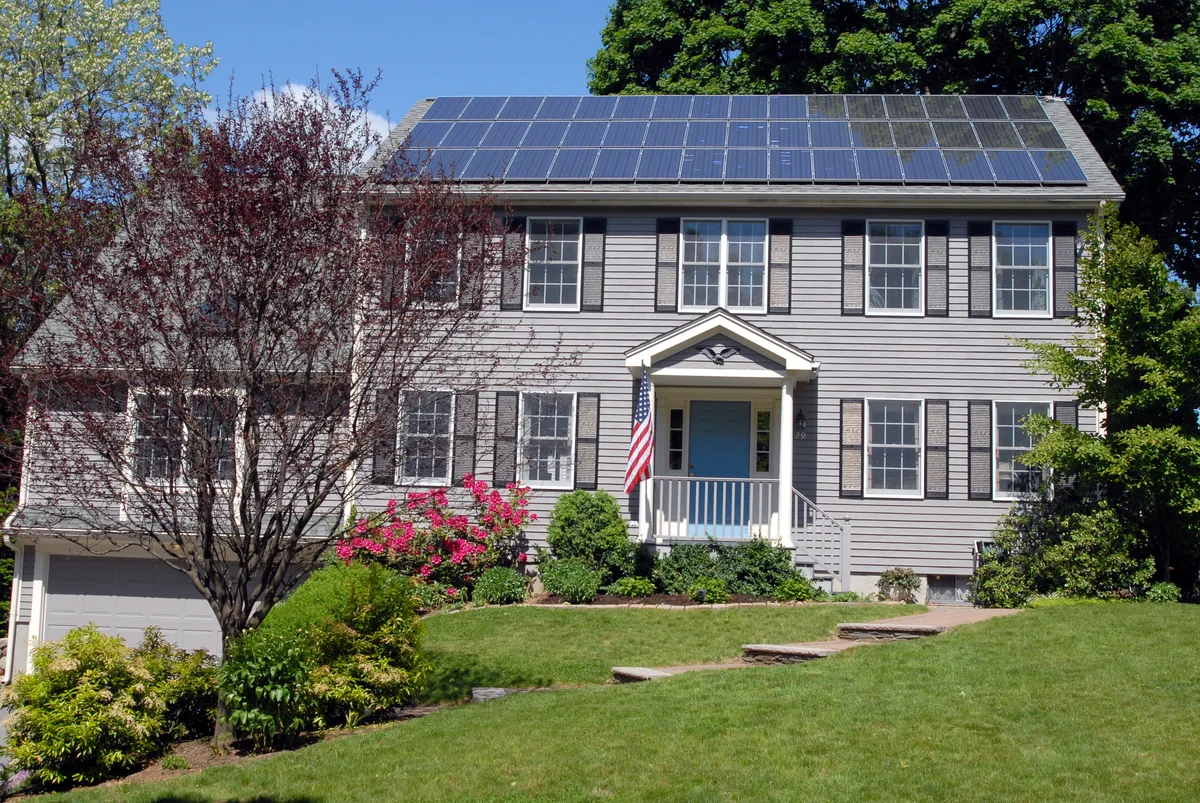
Featured image credit: Gray Watson, “Solar panels on house roof”, CC BY-SA 3.0. The locally displayed copy was converted to WebP and is shared under the same license.
1. Estimate the energy the home uses
Use utility records where available, then identify loads that may be added, moved off-grid, or used in different seasons. For individual appliances, estimate energy as power (W) × operating time (hours) ÷ 1,000 = energy (kWh). A nameplate rating is not necessarily the appliance’s average draw; use measured consumption or manufacturer data where possible.
The entries below are a hypothetical load profile, not a measured or typical home. The power and hours are chosen for arithmetic practice. They do not represent surveyed Energy Star, pump, heat-pump, router, or appliance performance.
| Example load | Assumed power | Assumed time | Calculated energy |
|---|---|---|---|
| Refrigerator | 150 W | 8 h/day | 1.20 kWh/day |
| Well pump | 1,000 W | 1.5 h/day | 1.50 kWh/day |
| Mini-split | 900 W | 8 h/day | 7.20 kWh/day |
| Internet equipment | 50 W | 24 h/day | 1.20 kWh/day |
| Lighting | 100 W | 5 h/day | 0.50 kWh/day |
| Computers and charging | 120 W | 6 h/day | 0.72 kWh/day |
| Induction cooktop | 1,400 W | 0.75 h/day | 1.05 kWh/day |
| Washing machine | 500 W | 1 h/day | 0.50 kWh/day |
| Arithmetic total | 13.87 kWh/day |
Round that made-up profile to 14.0 kWh/day only for the example below. Actual duty cycles, operating schedules, standby draw, and seasonal loads can make a real home substantially different. Energy use in kWh also does not reveal simultaneous power or motor-starting demand; those need separate load and equipment data.
2. Choose a location- and month-specific solar input
Solar resource changes with location, season, weather, surface orientation, horizon, and shading. An annual average can conceal a winter shortfall. For a planning estimate, examine monthly production for the intended location and a stated array configuration. The NREL PVWatts calculator estimates PV output from user-supplied system and location inputs; it does not model this household’s battery dispatch, backup supply, or guarantee off-grid service. NASA POWER provides solar and meteorological data for screening, not a completed site design.
Use resource data that matches the plane and period you are estimating, and record the source, dataset period, tilt, azimuth, and other assumptions. Do not treat a broad regional sun-hours table as a forecast for a particular roof. A peak-sun-hour value is an input to a simplified equation, not a promise that a system will deliver that energy every day.
3. Use a transparent panel-count calculation
A simplified first-pass equation is:
Array nameplate power (W) = daily energy demand (Wh/day) ÷ [solar resource (h/day) × assumed delivery fraction]
For a worked illustration, assume 14,000 Wh/day, 3.8 equivalent sun-hours/day, and a 0.77 delivery fraction. These are scenario inputs, not a recommended or measured combination. The result is 14,000 ÷ (3.8 × 0.77) ≈ 4,785 W, or about 4.79 kW of array nameplate power. If an example module is rated at 400 W, 4,785 ÷ 400 ≈ 11.96, which rounds up to 12 modules by nameplate arithmetic.
The 0.77 value is an assumed aggregate factor for this example, not a universal off-grid efficiency or an NREL, NASA, NEC, or CEC recommendation. Temperature, inverter and controller operation, wiring, shade, soiling, snow, battery charging, and load timing vary. Do not stack generic percentages or count a loss twice. Replace the scenario inputs with a model using the intended location, month, equipment, and system configuration; then check whether its output aligns with the loads and backup plan.
Module wattage is a laboratory nameplate rating under stated test conditions, not a daily-energy rating. Confirm the exact module datasheet and the selected inverter/controller operating limits before evaluating any real array configuration.
4. Compare months, roof area, and site constraints
Check the months when the system must serve the loads, not just annual energy totals. If modeled production and demand differ by month, evaluate load flexibility, storage, other generation, and the consequences of a shortfall. No fixed percentage of extra panels or universal number of autonomy days guarantees service through a particular weather event.
For a rough footprint, multiply the exact module’s dimensions by the proposed module count. That is module surface area only; it excludes spacing, roof features, access, setbacks, mounting layout, and structural capacity. Those constraints depend on the roof and local requirements. A generic ridge or edge clearance is not a code determination.
Shading effects depend on the shade pattern, module construction, bypass-diode layout, string design, and power electronics. A percentage shaded on one module does not translate to one universal percentage loss for a string or system. Assess obstructions over the relevant times of year and use the module and inverter documentation for the proposed design.
5. Keep panel count separate from electrical design
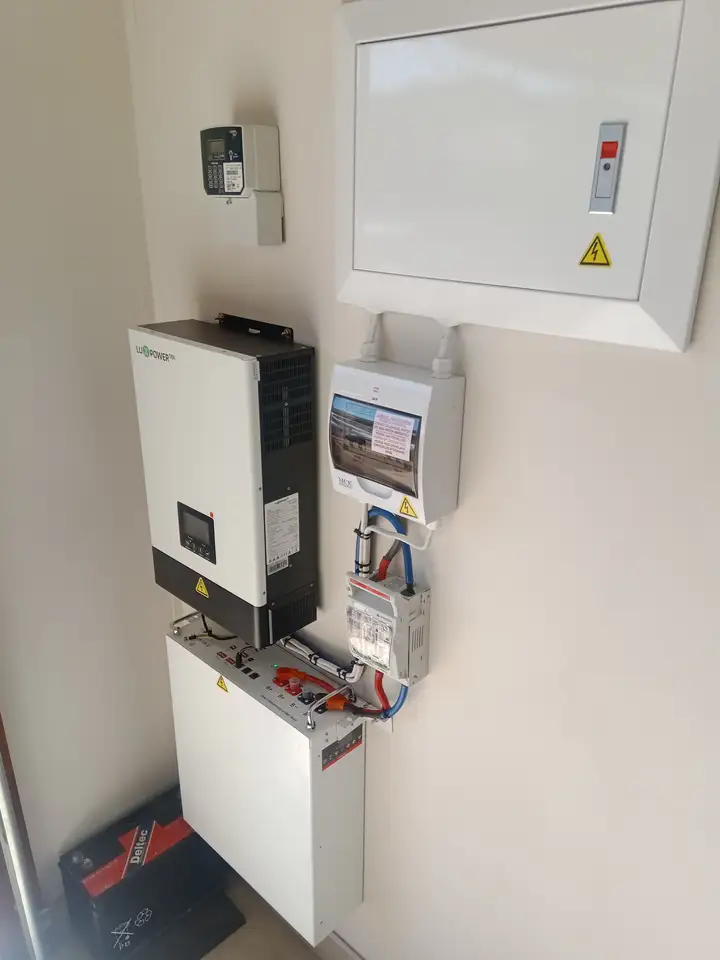
A daily-energy calculation does not determine inverter power, battery capacity, controller selection, string voltage, conductor size, overcurrent protection, grounding, or code compliance. Simultaneous and starting loads, battery limits, module electrical specifications, minimum design temperature, equipment instructions, and local rules can change those decisions. The article’s panel-count arithmetic is not a wiring plan.
Compare the exact module, inverter, controller, and battery documentation. For wiring or installation decisions, use current manufacturer instructions and requirements that apply to the specific jurisdiction and installation; do not derive a design from the simplified examples here.
Frequently Asked Questions
There is no fixed answer without a location- and month-specific solar input and stated system assumptions. For illustration only, 20,000 Wh/day divided by 4.0 assumed sun-hours/day and a 0.77 assumed delivery fraction is about 6,494 W. At an assumed 400 W per module, that rounds up to 17 modules by nameplate arithmetic; it is not a production or reliability guarantee.
No. The 0.77 value in this article is only an input to an illustrative calculation. Actual modeled production depends on site, period, orientation, shade, weather, components, and operating conditions; use source data and equipment-specific assumptions.
Not by itself. Compare monthly solar resource and demand for the location and intended array orientation. An annual average can hide a seasonal energy gap and does not predict multi-day weather.
Multiply the dimensions of the exact module by the proposed count for its nominal surface area. Available roof area also depends on layout, obstructions, access, structural capacity, and applicable local requirements; no single setback applies everywhere.
No. The effect depends on the shade pattern, module bypass diodes, string layout, and power electronics. Evaluate the actual site and equipment rather than applying a universal percentage.
No. Energy, simultaneous power, starting demand, storage, controller limits, wiring protection, and installation rules are separate questions. This simplified calculation does not select equipment or provide installation instructions.
Sources and further estimation
- U.S. Department of Energy, Solar Photovoltaic System Design Basics, for general PV system components and mounting context.
- NREL, PVWatts and PVWatts API version 8 documentation, for modeled production using stated location and system inputs. PVWatts is not an off-grid load, battery-dispatch, or reliability model.
- NASA, POWER Data Access Viewer, for solar and meteorological data; selected data still need interpretation for the proposed array plane and system.
Sources checked October 4, 2026. Dataset versions, product specifications, and local requirements can change; verify the inputs and current documentation for the actual site and equipment.