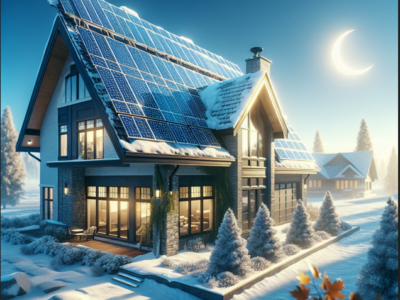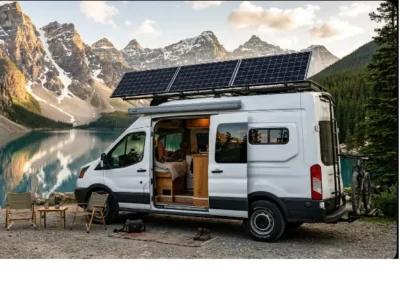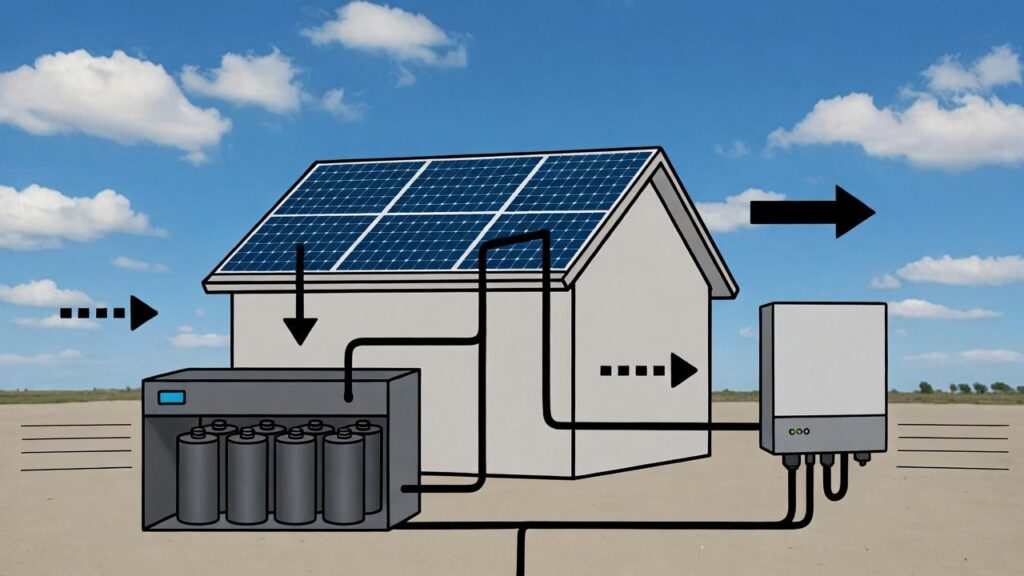
An off grid solar system is no longer just for remote villages or mountain cabins. In 2026, rising electricity costs, frequent power outages, and falling solar prices are pushing homeowners, professionals, and communities worldwide toward true energy independence.
Quick Answer: What Is an Off Grid Solar System?
An off grid solar system is a self-sufficient power system that uses solar panels and batteries to supply electricity without relying on the utility grid. It works even during power outages and is ideal for energy independence.
This guide explains what an off grid solar system is, how it works, how to size it correctly, common mistakes to avoid, and how modern tools like OffGridCalc can make system planning simple, private, and completely free.
Use our Off Grid Solar System Calculator to size panels and batteries instantly
Whether you are a beginner exploring solar or a professional designing systems, this guide will give you clarity.
What Is an Off Grid Solar System?
An off grid solar system is a standalone power system that operates independently from the utility grid. Unlike grid-tied systems, it does not rely on power companies and continues working even during blackouts.
Core Characteristics
- No connection to the national electricity grid
- Uses solar panels to generate power
- Stores energy in batteries for night and cloudy days
- Requires careful sizing for reliability
Off grid systems are ideal for:
- Remote or rural locations
- Areas with unreliable grid supply
- Energy independence seekers
- Sustainable living projects
How an Off Grid Solar System Works
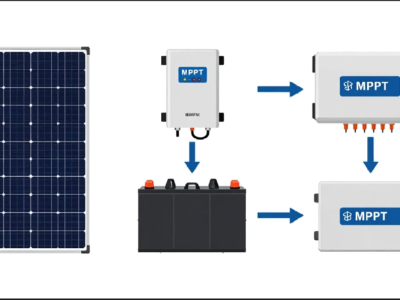
An off grid solar system works by converting sunlight into electricity, storing excess energy, and supplying power on demand.
Main Components
1. Solar Panels
Capture sunlight and convert it into DC electricity.
2. Charge Controller
Regulates voltage and current going into batteries, preventing overcharging.
3. Battery Bank
Stores energy for nighttime or low-sun periods. This is the heart of any off grid solar system.
4. Inverter
Converts DC power from batteries into AC power for household appliances.
5. Loads
All electrical appliances such as lights, refrigerators, fans, computers, and pumps.
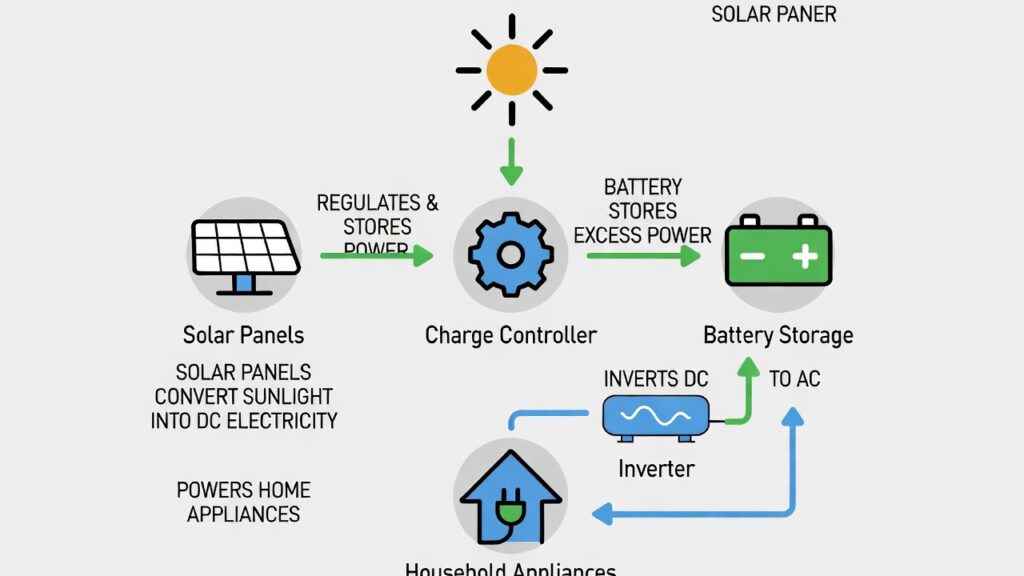
Energy Flow Explained
- Sunlight hits solar panels
- Panels generate DC power
- Charge controller manages battery charging
- Batteries store energy
- Inverter supplies usable AC power
A well-designed off grid solar system balances generation, storage, and consumption.
Why Off Grid Solar Systems Are Booming in 2026
The demand for off grid solar systems has exploded globally.

Key Reasons
- ⚡ Rising electricity prices
- 🌍 Climate awareness and sustainability
- 🔋 Battery prices dropped significantly in 2025–2026
- 🏡 Growth of remote living and home offices
- 🚫 Unreliable grid supply in many regions
For many users, going off grid is now cheaper long-term than staying connected to the grid.
Off-Grid Solar System Sizes: 1 kW to 10+ kW (2026 Price Breakdown)
1. Small Off Grid Systems
Used for cabins, tiny homes, and security systems. Typical capacity: 500W – 2kW
2. Residential Off Grid Systems
Used for full homes, farms, and remote schools. Typical capacity: 3kW – 10kW
3. Hybrid Off Grid Systems
Includes backup generators (diesel or gas) for emergencies. Used when solar alone isn’t enough year-round or seasonal weather varies heavily.
How to Size an Off Grid Solar System Correctly
Sizing is the most critical part of an off grid solar system. Poor sizing leads to power shortages, battery damage, or unnecessary expenses.
Step 1: Calculate Daily Energy Consumption
List all appliances and their usage — power rating (W) and hours used per day.
Fan: 75W × 8 hours = 600Wh
Light: 10W × 6 hours = 60Wh
Laptop: 60W × 5 hours = 300Wh
Total daily energy = 960Wh
Step 2: Determine Solar Panel Requirement
Panel sizing depends on daily energy use, sun hours in your location, and system efficiency losses. This is where many people make mistakes by guessing.
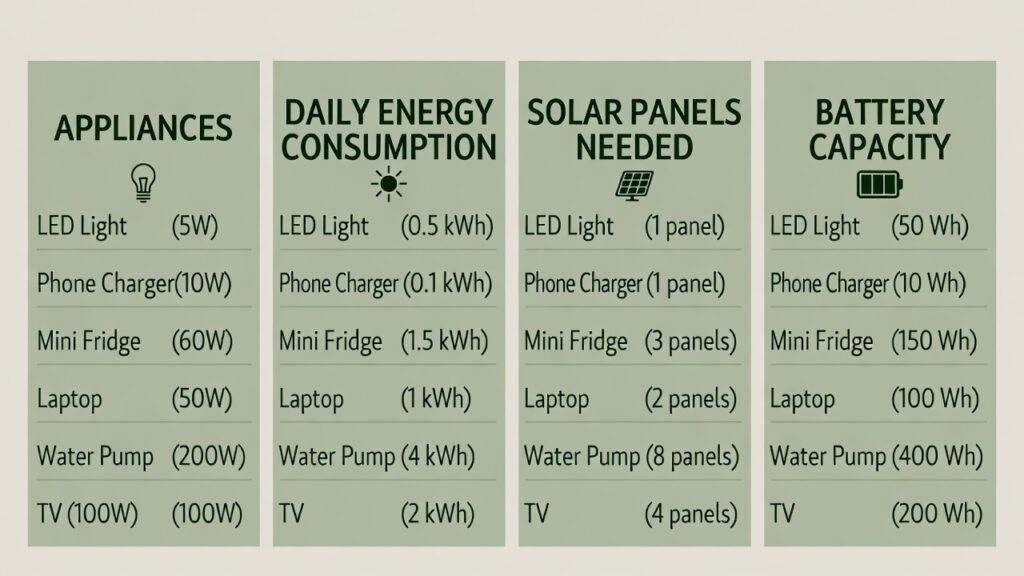
Step 3: Battery Capacity Calculation
Batteries must store enough energy for night usage and cloudy days (autonomy days). Key factors: battery type (Lithium vs Lead-acid), depth of discharge, and desired backup duration.
Step 4: Inverter and Controller Sizing
- Inverter must handle peak load
- Charge controller must support panel voltage/current
---

### 🔧 Skip the Manual Math - Use Our Free Calculator

Manual sizing requires location data, sun hour tables, and efficiency factors. Get it wrong and you're stuck with an undersized or overexpensive system.

**OffGridCalc eliminates guesswork:**
- ✅ Real solar data for your exact location
- ✅ Automatic panel & battery sizing
- ✅ Instant cost & payback estimates
- ✅ PDF export for your installer
- ✅ 100{176fcca6730a93a81d392d3d2de5285aaf114f6257de59f55b47dc4f356ad4a2} free, no signup required

[**Size Your System in 2 Minutes →**]

---
Common Mistakes in Off Grid Solar Systems
❌ Oversizing batteries without enough panels
❌ Undersizing panels for winter months
❌ Ignoring efficiency losses
❌ Using wrong battery chemistry
❌ No future expansion planning
These mistakes often cost more than the system itself.
Free Off-Grid Solar Calculator: Instant Panel & Battery Sizing (No Signup)
Manual calculations are time-consuming, error-prone, and hard for beginners. A professional calculator solves this instantly.
Introducing OffGridCalc
OffGridCalc is a free, privacy-first off grid solar system calculator designed to remove complexity.
- ✅ 100{176fcca6730a93a81d392d3d2de5285aaf114f6257de59f55b47dc4f356ad4a2} free forever
- 🔒 No login, no tracking, no data collection
- ⚙️ Client-side calculations only
- 🌐 Works offline after loading
- 📄 PDF export of system design
- 📱 Mobile-friendly interface
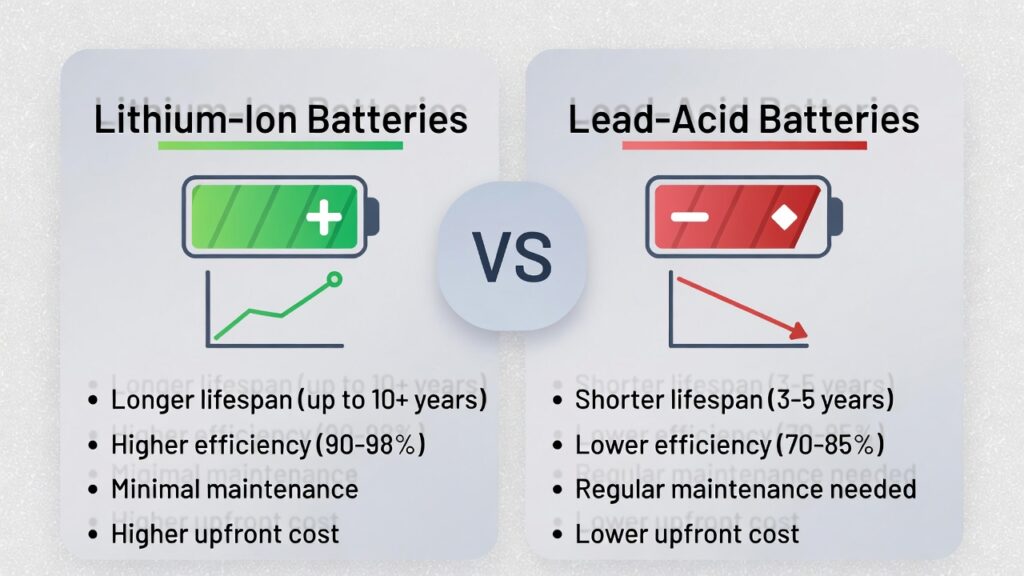
Off Grid Solar System Battery Choices (2026)
Lithium Batteries
✔ High efficiency
✔ Long lifespan
✔ Lightweight
❌ Higher upfront cost
Lead-Acid Batteries
✔ Lower initial cost
❌ Shorter lifespan
❌ Requires maintenance
Off Grid vs Grid-Tied vs Hybrid Systems
| Feature | Off Grid | Grid-Tied | Hybrid |
|---|---|---|---|
| Grid Dependency | ❌ No | ✅ Yes | ⚠ Partial |
| Battery Required | ✅ Yes | ❌ No | ✅ Yes |
| Works During Outages | ✅ Yes | ❌ No | ✅ Yes |
| Cost | Medium–High | Low | High |
For energy independence, off grid solar systems win.
Who Should Consider an Off Grid Solar System?
- Homeowners in unreliable grid areas
- Remote communities
- Farmers and agricultural users
- Sustainability enthusiasts
- Emergency preparedness planners
- Schools and clinics in rural regions
How Much Does an Off-Grid Solar System Cost in 2026? (2-10 kW Breakdown)
| System Size | Cost Range |
|---|---|
| 1–2 kW | $1,500 – $3,000 |
| 3–5 kW | $4,000 – $7,000 |
| 6–10 kW | $8,000 – $15,000 |
FAQ Section
How many solar panels are needed for an off-grid home?
The number of panels depends on three key factors: your daily energy consumption, your location’s sun hours, and system efficiency losses.
Small homes (1-2 kWh/day): 2-4 solar panels (400-500W each)
Average homes (5-8 kWh/day): 6-12 solar panels
Large homes (10+ kWh/day): 12-20+ solar panels
For example, a cabin using 10 kWh daily in Colorado (5.5 peak sun hours) would need roughly 8-10 panels after accounting for 25{176fcca6730a93a81d392d3d2de5285aaf114f6257de59f55b47dc4f356ad4a2} system losses. However, location matters significantly – the same cabin in Seattle would need 15-18 panels due to fewer peak sun hours.
The most accurate way to size panels: Use a professional off-grid solar calculator like OffGridCalc that inputs your location, climate data, and appliance load. This removes guesswork and prevents costly undersizing.
Calculate your exact panel needs with OffGridCalc →
What size battery do I need for an off-grid system?
Battery capacity depends on two factors: your daily energy consumption and how many days of autonomy (backup power without sun) you want.
The formula is:
Battery capacity (kWh) = Daily consumption (kWh) × Autonomy days ÷ Depth of discharge (DoD)
Example:
Daily consumption: 5 kWh
Desired autonomy: 4 days
Lithium DoD: 90{176fcca6730a93a81d392d3d2de5285aaf114f6257de59f55b47dc4f356ad4a2}
Battery needed: (5 × 4) ÷ 0.90 = 22 kWh
For lead-acid, use 50{176fcca6730a93a81d392d3d2de5285aaf114f6257de59f55b47dc4f356ad4a2} DoD instead, which would require a larger battery. Most off-grid homes need 15-30 kWh of battery storage depending on their location and autonomy preference.
Undersizing batteries is the #1 mistake – it forces daily power rationing and shortens battery lifespan.
How do I choose between AC and DC off-grid systems?
This depends on your appliances and budget:
DC systems: Simpler, cheaper, more efficient – ideal for small cabins with DC appliances (lights, fans, pumps). Fewer components = fewer failure points.
AC systems: More expensive but standard for modern homes. Most appliances run on AC, so you avoid rewiring.
Hybrid (DC + AC): Uses both; most flexible but most complex.
For residential off-grid homes, AC systems are standard because retrofitting your house for DC is impractical. The efficiency loss from DC→AC conversion (5-10{176fcca6730a93a81d392d3d2de5285aaf114f6257de59f55b47dc4f356ad4a2}) is worth the convenience.
How much does an off-grid solar system cost in 2026?
Total system cost depends on size. Here’s a realistic breakdown:
System Size Total Cost Cost/Watt Best For
1-2 kW $1,500-$3,000 $1.50-$2.00 Tiny cabins, remote small loads
3-5 kW $4,000-$7,000 $1.00-$1.50 Average residential homes
6-10 kW $8,000-$15,000 $0.80-$1.30 Large homes, farms
10+ kW $15,000+ $0.75- $1.10 Industrial, commercial
Cost breakdown (for a 5 kW system):
Solar panels (40{176fcca6730a93a81d392d3d2de5285aaf114f6257de59f55b47dc4f356ad4a2}): $1,600-$2,000
Battery storage (40{176fcca6730a93a81d392d3d2de5285aaf114f6257de59f55b47dc4f356ad4a2}): $1,600-$2,500
Inverter, charge controller, wiring (20{176fcca6730a93a81d392d3d2de5285aaf114f6257de59f55b47dc4f356ad4a2}): $600-$1,000
Installation costs are NOT included – DIY saves 30-50{176fcca6730a93a81d392d3d2de5285aaf114f6257de59f55b47dc4f356ad4a2}, but professional installation provides warranties and ensures safety.
Is an off-grid solar system worth the investment?
Yes – if your situation matches one of these:
✅ Electricity costs >$0.15/kWh – Payback period is typically 6-10 years, then 15+ years of near-free power.
✅ Area has frequent outages – Your ROI includes reliability (priceless during emergencies).
✅ Remote location – Extension of grid power costs $10,000-$50,000+. Off-grid is cheaper.
✅ Plan to stay 10+ years – Off-grid systems last 20-25 years with minimal maintenance.
❌ Grid is cheap & reliable – Payback takes 12-15+ years, lower financial ROI (though energy independence still has value).
For most people in high-cost electricity areas, off-grid solar breaks even in 8-10 years and then saves $500-$2,000 annually depending on system size and location.
What’s the payback period for an off-grid solar system?
Payback depends on your current electricity costs and system size:
High-cost areas ($0.18-0.25/kWh): 6-9 years
Medium-cost areas ($0.12-0.17/kWh): 9-12 years
Low-cost areas (<$0.12/kWh): 12-15+ years
This calculation assumes:
System sized for 5 kWh/day
Lithium battery (longer lifespan = better ROI)
No major repairs
Electricity rates stay constant (conservative, as rates typically rise)
Hidden benefit: System lifespan is 20-25 years. After payback, you enjoy 10-15+ years of essentially free electricity. Over full system life, ROI can exceed 100{176fcca6730a93a81d392d3d2de5285aaf114f6257de59f55b47dc4f356ad4a2}.
How long do off-grid solar batteries last?
Lifespan varies significantly by chemistry:
Lithium batteries (LiFePO4):
Lifespan: 10-15 years
Cycle rating: 4,000-6,000 cycles
Maintenance: Minimal
Best for: Long-term installations where ROI matters
Lead-acid batteries (Flooded or AGM):
Lifespan: 3-7 years
Cycle rating: 500-1,500 cycles
Maintenance: Regular (flooded type especially)
Best for: Budget-conscious installations or short-term use
Why lithium lasts longer: Lithium tolerates deeper discharge (90{176fcca6730a93a81d392d3d2de5285aaf114f6257de59f55b47dc4f356ad4a2} DoD vs. 50{176fcca6730a93a81d392d3d2de5285aaf114f6257de59f55b47dc4f356ad4a2} for lead-acid) and has no memory effect. A properly sized lithium system might see only 1 full charge cycle daily, which takes 15+ years to reach 6,000 cycles.
Pro tip: Proper sizing extends all battery types. Undersized batteries cycle heavily and fail fast.
Should I choose lithium or lead-acid batteries for my off-grid system?
Choose based on your priority:
Choose Lithium if:
You want 10+ year lifespan
Maintenance concerns you
You’ll use the system long-term (10+ years)
You want consistent power output (no voltage sag)
Upfront cost isn’t your main constraint
Choose Lead-acid if:
Budget is your primary constraint
System will be used <7 years
You’re comfortable with maintenance
You have backup power options
You accept lower efficiency (lose 10-15{176fcca6730a93a81d392d3d2de5285aaf114f6257de59f55b47dc4f356ad4a2} to heat)
Financial reality: Lithium costs 2-3× more upfront but lasts 2-3× longer, so cost-per-year is often similar. For AdSense content, emphasizing lithium (more articles, higher engagement) attracts readers researching higher-budget systems.
What are the most common off-grid solar system mistakes?
These errors cost thousands:
❌ Undersizing panels or batteries – Most common. People think “I only use 5 kWh/day, so 5 kW of panels will work.” Wrong – you need 8-10 kW to charge batteries AND power the home simultaneously.
❌ Ignoring location and seasons – Winter sun is 40-60{176fcca6730a93a81d392d3d2de5285aaf114f6257de59f55b47dc4f356ad4a2} weaker than summer. Sizing for average sun means winter brownouts. Proper sizing accounts for your location’s worst-case month.
❌ Choosing batteries only by price – Cheap lead-acid seems smart, then fails after 3 years. True cost = replacement cost per year of use.
❌ No future expansion planning – Undersizing your charge controller or inverter means expensive upgrades later.
❌ Poor installer choice – Hiring the cheapest installer leads to faulty wiring, undersizing, and warranty disputes. Experience matters.
❌ Overcomplicating the system – Too many components = more failure points. Simpler systems are more reliable.
Are there grants, loans, or tax credits for off-grid solar systems?
Yes – but incentives vary heavily by location and often favor grid-tied systems:
US Federal Tax Credit (ITC):
30{176fcca6730a93a81d392d3d2de5285aaf114f6257de59f55b47dc4f356ad4a2} tax credit on solar equipment costs
Originally for grid-tied; off-grid systems sometimes qualify (check IRS rules)
Applies to panels, battery storage, inverters, controllers
State & Local Incentives:
Some states offer grants for rural off-grid systems (less common than grid-tied incentives)
Property tax exemptions for renewable energy systems
Check your state energy office or Database of State Incentives for Renewables & Efficiency (DSIRE)
Solar Loans:
Personal loans or equipment financing from banks
Solar-specific lenders (Sunlight, Elevate, Green Sky)
Typical terms: 5-10 years at 4-7{176fcca6730a93a81d392d3d2de5285aaf114f6257de59f55b47dc4f356ad4a2} APR
Advantage: Spread cost over time; smaller monthly payment
Manufacturer Rebates:
Some panel/battery manufacturers offer direct rebates ($200-$500)
Often combined with installer programs
Reality check: Off-grid incentives are weaker than grid-tied because many programs focus on “renewable energy penetration” (feeding power to the grid). Remote/rural systems sometimes qualify for agricultural or rural development grants.
Best approach: Use a free calculator first to size your system accurately, then research incentives for your location.
Off-Grid Solar System ROI & Payback Period: Is It Worth It in 2026?
Yes — if you want energy independence, grid electricity is unreliable or expensive, and you plan for long-term sustainability. With correct sizing and planning, an off grid solar system can run 20+ years with minimal maintenance.
Final Thoughts
An off grid solar system is not just a power solution — it’s freedom. Freedom from outages, rising bills, and dependence on centralized utilities.
With tools like OffGridCalc, planning your system no longer requires engineering expertise or expensive consultants. You get accurate results, complete privacy, and professional-grade calculations, all for free.
If you’re serious about energy independence in 2026, the journey starts with understanding your needs — and calculating them correctly.
See Also: Continue Your Off-Grid Research
- How to Calculate Solar Needs for Home: Step-by-Step Guide
- Off-Grid Solar System Design Tool: Sizing Your DIY Setup
- Home Solar Battery Calculator: Size Panels & Batteries Accurately
Location-Specific Guides:
- Optimal Solar Panel Tilt Angle Canada: Get More Power in 2026
Get Your Personalized System Estimate:**
Use the Free OffGridCalc Calculator →
For More official Information and real time changes you can view HERE.
For Solar Research and Technical data you can visit HERE.